Best Helpdesk for Startups (2026)
Most helpdesks are built for enterprises. Here's what actually works when you're small, scrappy, and watching every dollar.
Here’s the thing about helpdesk software: most of it is designed for companies way bigger than yours.
Zendesk’s pricing assumes you have a budget. Freshdesk’s feature set assumes you have dedicated support staff. Intercom assumes you’re ready for “customer engagement” when really you just need to answer emails without things falling through the cracks.
As someone who’s worked with a lot of startups on their support setup, I’ve seen what actually works at the early stage—and it’s rarely what the comparison articles recommend.
What Startups Actually Need
Before we get to specific tools, let’s talk about what matters when you’re small.
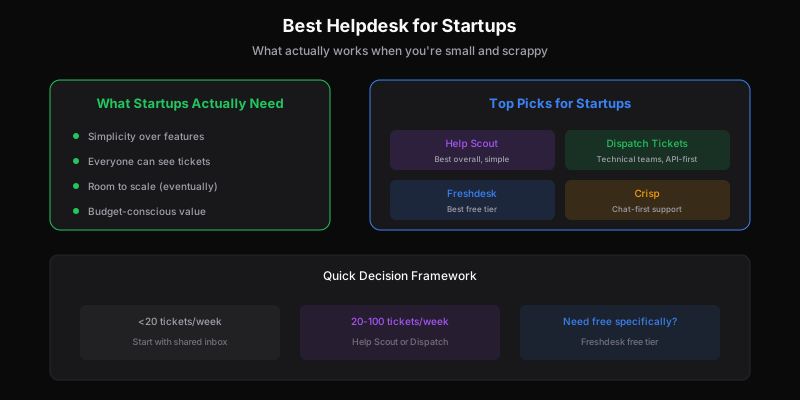
You don’t need features. You need simplicity. Every feature is a thing you might configure wrong. Every setting is a distraction. At the early stage, the best tool is the one that gets out of your way and lets you talk to customers.
Everyone should be able to see tickets. At a startup, support isn’t just the support team’s job. Founders need to see what customers are saying. Engineers need context when bugs are reported. Per-seat pricing actively punishes this cross-functional access.
You need to scale eventually. The tool that’s perfect at 50 tickets/month might not work at 500. Think one step ahead—not enterprise, but growth-stage.
Budget matters, but not the way you think. The cheapest option isn’t always the best value. A free tool that wastes an hour of founder time daily costs more than a paid tool that doesn’t.
The Startup Helpdesk Shortlist
Help Scout — Best Overall for Early Stage
Help Scout is what I usually recommend to startups who ask “what should we use?”
It’s simple without being simplistic. The interface is clean, setup takes hours not days, and your team can be productive immediately. The knowledge base (Docs) is excellent. Beacon gives you a help widget without Intercom complexity.
What works: Feels like email. Fast to learn. Doesn’t get in your way. Great for teams who value customer relationships.
What doesn’t: Per-user pricing means adding people costs money. API is basic if you want to build on it. No live chat in the traditional sense.
Pricing: $20/user/month Standard, $40/user Plus.
Best for: Startups with 2-10 support team members who want something that just works.
Compare Help Scout Alternatives →
Dispatch Tickets — Best for Technical Founders
If your instinct is “I want to build this into our product” or “I want everyone on the team to see support without paying per seat,” Dispatch Tickets is built for you.
It’s API-first, which means everything you can do in the UI, you can do programmatically. Per-ticket pricing means unlimited users—founders, engineers, PMs can all see what customers are saying. Multi-brand is included if you’re running multiple products.
What works: Engineers love the API. Per-ticket pricing rewards efficiency, not headcount. Grows with you without pricing pressure.
What doesn’t: Newer product, smaller ecosystem. No live chat. Less hand-holding than established players.
Pricing: Free tier available. $29/month for 1,000 tickets, unlimited users.
Best for: Technical startups who want support infrastructure they can build on.
See Dispatch Tickets pricing →
Freshdesk — Best Free Tier
Freshdesk’s free tier is genuinely useful—not just a trial or a teaser. Up to 10 agents, basic ticketing, knowledge base, and email channel. For a bootstrapped startup, that might be all you need for a long time.
The paid tiers are reasonable too. Growth at $15/agent gives you automation and SLA tracking. Pro at $49/agent adds multi-brand and custom reports.
What works: Free tier is real. Feature-complete if you grow into paid tiers. Established company, won’t disappear.
What doesn’t: Per-agent pricing adds up as you scale. Interface has gotten more complex over the years. You’ll eventually hit paywalls.
Pricing: Free for up to 10 agents. Paid from $15/agent/month.
Best for: Bootstrapped startups who need something now and will worry about scaling later.
Compare Freshdesk Alternatives →
Crisp — Best for Chat-First Startups
If your support is mostly chat—live website chat, in-app messaging—Crisp offers a compelling package at startup-friendly prices.
The pricing model is different: per-workspace, not per-user. $25/month gets you 4 seats. For a small team that needs chat, this is hard to beat economically.
What works: Chat-first design. Per-workspace pricing is startup-friendly. Chatbot automation included.
What doesn’t: Ticketing is secondary to chat. Less mature than dedicated helpdesks. Some reliability concerns reported.
Pricing: Free tier available. Pro at $25/workspace/month with 4 seats.
Best for: Startups where live chat is the primary support channel.
Linear — Best for Technical Issues Only
This is a non-obvious pick, but hear me out: if your “support” is mostly bug reports and feature requests from technical users, Linear might work better than a helpdesk.
Linear is a project management tool, but it handles technical feedback beautifully. Public intake forms, voting, status tracking, direct connection to engineering work. Some dev-tools startups use it instead of support software.
What works: If support is mostly technical, connects directly to engineering workflows. Clean, fast interface. Pricing includes unlimited users.
What doesn’t: Not a helpdesk. No email support, no knowledge base, no traditional ticketing. Only works for technical feedback.
Pricing: Free tier available. Paid from $8/user/month.
Best for: Developer-focused startups where “support” is really “issue tracking.”
What About Zendesk and Intercom?
You’ll see these on every “best helpdesk” list. They’re fine tools. But for startups specifically:
Zendesk starts at $55/agent/month for Suite Team. It’s powerful but expensive and complex. Unless you’re well-funded and expect enterprise deals soon, it’s probably overkill.
Intercom is even pricier and more complex. Great for product-led SaaS with in-app engagement, but the pricing is notoriously unpredictable. I’ve seen startups get burned by surprise bills.
Both make sense eventually. Neither makes sense at the early stage for most startups.
The Real Question: Do You Need Helpdesk Software?
Honest answer: maybe not yet.
If you’re getting 5 support emails a day, a shared Gmail inbox might be fine. Add some labels, have a system for who handles what, and you’re done. The transition to helpdesk software can wait until things actually break.
You need a helpdesk when:
- Tickets fall through cracks (no clear ownership)
- You can’t tell what’s open vs. resolved
- Multiple people are working on the same email
- You want metrics (response time, volume, etc.)
- New hires can’t figure out the process
If none of those apply, you might be prematurely optimizing.
Quick Comparison
| Tool | Starting Price | Pricing Model | Best For |
|---|---|---|---|
| Help Scout | $20/user | Per-user | General early-stage |
| Dispatch Tickets | Free | Per-ticket | Technical teams |
| Freshdesk | Free | Per-agent | Bootstrapped budgets |
| Crisp | Free | Per-workspace | Chat-first support |
| Linear | Free | Per-user | Technical issues only |
My Recommendation
If you’re a startup asking “what helpdesk should I use?” here’s my framework:
Under 20 tickets/week: Start with shared inbox. Seriously. Don’t overcomplicate.
20-100 tickets/week, non-technical: Help Scout. Simple, effective, reasonable price.
20-100 tickets/week, technical team: Dispatch Tickets. API-first, unlimited users, grows with you.
Need free specifically: Freshdesk’s free tier or Dispatch Tickets’ free tier, depending on whether you want established features or modern simplicity.
Chat-heavy support: Crisp. Best chat value at startup scale.
The worst thing you can do is spend three weeks evaluating enterprise helpdesks when you should be talking to customers. Pick something reasonable, commit for 6 months, and move on.
Related
Ready to get started?
Join the waitlist and start building better customer support into your product.
Get Early AccessFrequently Asked Questions
For most startups: Help Scout for simplicity, Dispatch Tickets for technical teams wanting API access, or Freshdesk's free tier if budget is the priority. Avoid Zendesk and Intercom early—they're expensive and complex for what most startups actually need.
Not always. Under 20 tickets/week, a shared inbox often works fine. Get helpdesk software when tickets fall through cracks, you can't tell what's open vs. resolved, or multiple people work the same emails. Don't solve problems you don't have yet.
Freshdesk's free tier (10 agents, unlimited tickets) is the most functional. Dispatch Tickets free tier offers unlimited users but limits tickets to 100/month. Both are genuinely usable, not just trials.
Usually not early on. Zendesk starts at $55/agent/month, is complex to configure, and designed for larger teams. It makes sense eventually for well-funded startups approaching enterprise sales, but simpler tools work better at early stage.