Help Scout Alternatives for Startups
Help Scout's per-seat pricing limits who can see customer feedback. Compare alternatives that let your whole team stay close to customers.
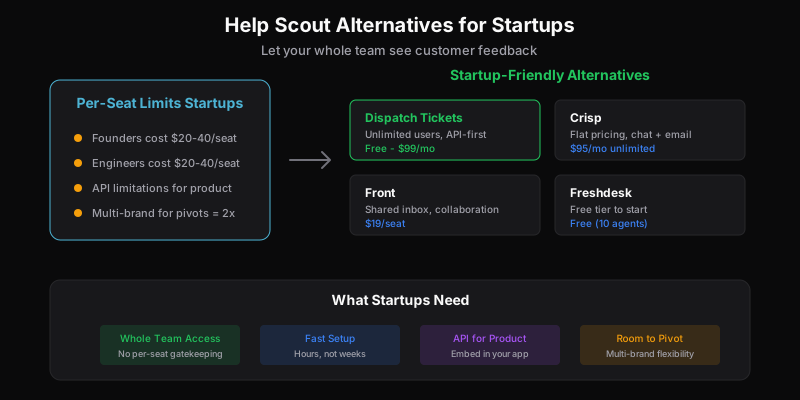
Help Scout is a solid choice for startups—simple, fast to set up, and doesn’t require a dedicated admin. Many startups start here.
But as you grow, Help Scout’s per-seat model creates friction. The people who should see customer feedback (founders, engineers, PMs) each cost $20-40/month. That friction shapes who has access.
Here’s what startups consider when Help Scout’s model stops fitting.
Why Startups Leave Help Scout
1. Per-Seat Limits Visibility
Early-stage startups thrive when everyone feels customer pain:
- Founders stay close to users
- Engineers see bugs firsthand
- PMs read feature requests directly
At $20-40/seat, adding these roles becomes a budget conversation. The typical result: support team becomes gatekeepers, summarizing feedback instead of everyone seeing it raw.
2. API Limitations
Startups building products want to embed support:
- Create tickets from error handlers
- Show support status in-app
- Sync customer context automatically
Help Scout’s API exists but isn’t first-class. Rate limits are tight. Some operations need multiple calls. Webhooks are basic.
3. Multi-Brand for Pivots
Startups pivot. Products evolve. You might end up supporting multiple products or brands.
Help Scout’s Standard plan ($20/user) is single-brand. Multi-brand needs Plus ($40/user). That’s a 100% price increase when you’re already stretched.
Best Help Scout Alternatives for Startups
1. Dispatch Tickets — Best for Whole-Team Access
Why it works: Per-ticket pricing means unlimited users. Founders, engineers, PMs—everyone can see customer feedback without per-seat costs. API-first for product integration.
Pricing: Free (100 tickets/month), $29/month (1,000 tickets), $99/month (10,000 tickets)
Startup fit:
- Whole team included
- API-first architecture
- Multi-brand for pivots
- Predictable costs
Trade-offs:
- Newer product
- Smaller ecosystem
- Building in public
Best for: Technical startups, SaaS, developer tools—anywhere the whole team should see customer feedback.
2. Crisp — Best for Flat Pricing
Why it works: Flat monthly pricing removes per-seat math. Chat + email unified. Fast setup for teams moving fast.
Pricing: Free (2 seats), $25/month (4 seats), $95/month (unlimited)
Startup fit:
- No per-seat scaling
- Chat + email in one place
- Quick to implement
- Unlimited seats at $95
Trade-offs:
- Chat-focused
- Less email-optimized
- Fewer integrations
Best for: Consumer startups, apps—anywhere chat is the primary channel.
3. Front — Best for Collaborative Teams
Why it works: If your startup has blurry lines between support, sales, and ops, Front adds collaboration to existing email rather than replacing it.
Pricing: $19/seat/month (Starter), $59/seat/month (Growth)
Startup fit:
- Works with Gmail/Outlook
- Good for mixed roles
- Strong collaboration
- Familiar email feel
Trade-offs:
- Still per-seat
- Not true ticketing
- Can get complex
Best for: Startups where one team handles support + sales + partnerships.
4. Freshdesk — Best Free Start
Why it works: Free tier for up to 10 agents lets you start without paying. Upgrade when you’re ready.
Pricing: Free (10 agents), $15/agent/month (Growth)
Startup fit:
- Truly free start
- Upgrade path exists
- More features than Help Scout
- Automation included
Trade-offs:
- Growing complexity
- Multi-brand needs Pro ($49/agent)
- Per-agent scaling
Best for: Startups wanting free until product-market fit, accepting complexity trade-off.
Comparison Table
| Tool | Free Tier | Per-Seat? | API | Best For |
|---|---|---|---|---|
| Dispatch Tickets | 100 tickets | No | Excellent | Whole-team access |
| Crisp | 2 seats | Flat at $95 | Good | Flat pricing |
| Front | No | Yes | Good | Collaboration |
| Freshdesk | 10 agents | Yes | Good | Free start |
| Help Scout | No | Yes | Basic | Simplicity |
The Startup Support Philosophy
Before picking a tool, consider what matters at your stage:
1. Founder proximity
Founders doing support is a competitive advantage. They hear feedback unfiltered. Tools should make this easy, not expensive.
2. Engineer access
Bugs become tickets become engineering work. Direct access to tickets means engineers see customer context, not summaries.
3. Speed over features
You need to respond fast. Complex tools slow you down. Features you’ll “grow into” are features that slow you down today.
4. Room to evolve
Your support needs will change. Pick something flexible or easy to migrate from.
When to Stay on Help Scout
Help Scout isn’t wrong for startups. Stay if:
- Team is under 5 people who all need access
- Simplicity matters more than cost
- You don’t need multi-brand yet
- API limitations aren’t blocking you
The Bottom Line
Help Scout’s per-seat model makes sense for dedicated support teams. It’s less ideal for startups where everyone should touch customer feedback.
Choose based on what matters:
- Whole-team access → Dispatch Tickets
- Flat pricing → Crisp
- Collaboration → Front
- Free start → Freshdesk
Most have free tiers. Start there.
Related
Ready to get started?
Join the waitlist and start building better customer support into your product.
Get Early AccessFrequently Asked Questions
Yes, especially early on. Direct customer contact provides invaluable product insights. Tools with per-seat pricing discourage this by making founder access expensive. Per-ticket pricing (Dispatch Tickets) or flat pricing (Crisp) avoid this.
Start simple. Help Scout or Dispatch Tickets let you respond in hours, not weeks. Avoid complex tools like Zendesk early. Focus on tools that let your whole team see customer feedback without per-seat gatekeeping.
When per-seat costs are limiting who sees customer feedback, when API limitations block product integration, or when multi-brand pricing ($40/user) blocks your growth.