Freshdesk Alternatives for Startups
Freshdesk is growing as complex as Zendesk. Compare lighter alternatives that match startup speed, budgets, and simplicity needs.
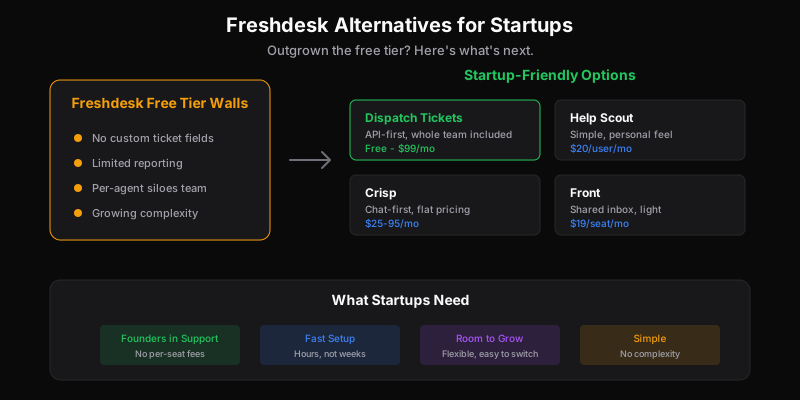
Freshdesk’s free tier made it a popular choice for startups. But as companies grow, the limitations become clear: features locked behind expensive tiers, per-agent pricing that discourages collaboration, and increasing complexity.
If you started on Freshdesk and are hitting walls, here’s what to consider next.
Why Startups Outgrow Freshdesk
1. The Free Tier Walls
Freshdesk’s free tier gets you started, but you quickly hit limits:
- No custom ticket fields
- Limited reporting
- No SLA management
- Basic automations only
- No customer satisfaction surveys
Moving to Growth ($15/agent) helps, but the good stuff—custom reports, multiple SLAs, multi-brand—needs Pro at $49/agent.
2. Per-Agent = Per-Budget-Conversation
Startups work best when everyone touches customer feedback. Engineering needs to see bugs. Product needs to see feature requests. Founders need to feel customer pain.
At $15-49/agent, adding people becomes a budget discussion. Startups end up with:
- Shared logins (security risk, ToS violation)
- One person gatekeeping feedback
- Context lost in translation
3. Growing Complexity
Freshdesk has grown complex. Automations, scenarios, rules, SLAs, canned responses, satisfaction surveys, business hours, escalations…
Early-stage startups need to respond to customers. They don’t need to configure workflow engines.
Best Freshdesk Alternatives for Startups
1. Help Scout — Best for Staying Close to Customers
Why it works: Help Scout keeps support feeling personal. Simple interface, fast setup, and a focus on conversations over tickets.
Pricing: $20/user/month (Standard), $40/user/month (Plus)
Startup fit:
- Running in an afternoon
- Feels like email, not enterprise software
- Great knowledge base (Docs)
- Beacon for in-app help
Trade-offs:
- Still per-user pricing
- Multi-brand needs Plus ($40/user)
- API is limited
Best for: B2C startups where customer relationships matter.
2. Dispatch Tickets — Best for Technical Teams
Why it works: API-first architecture means you can embed support in your product. Per-ticket pricing means engineers, PMs, and founders can all see customer feedback without per-seat costs.
Pricing: Free (100 tickets/month), $29/month (1,000 tickets), $99/month (10,000 tickets)
Startup fit:
- Unlimited users, pay for tickets
- API-first (embed in your product)
- Multi-brand included (pivot freely)
- Whole team can participate
- Open source portal
Trade-offs:
- Newer product (launched 2026)
- Smaller integration ecosystem
- No phone channel
Best for: SaaS startups, developer tools, technical products.
3. Crisp — Best for Chat-First
Why it works: If support is mostly live chat, Crisp bundles chat, email, and ticketing for a flat monthly price—not per-seat.
Pricing: Free (2 seats), $25/month (4 seats), $95/month (unlimited)
Startup fit:
- Flat pricing = predictable costs
- Chat + email in one place
- Quick setup
- Good for real-time support
Trade-offs:
- Chat-focused (email/ticketing basic)
- Fewer integrations
Best for: Consumer startups, apps, marketplaces—anywhere users expect live chat.
4. Front — Best for Shared Inbox
Why it works: If you don’t need full ticketing—just better email collaboration—Front adds team features to your existing inbox.
Pricing: $19/seat/month (Starter), $59/seat (Growth)
Startup fit:
- Works with existing email
- Team collaboration without complexity
- Good for non-support teams helping
- Fast setup
Trade-offs:
- Per-seat pricing
- Not full ticketing
- Limited at high volume
Best for: Early startups where support is handled by the whole team via email.
5. Freshdesk Free + Upgrade Later — Best for “Not Yet”
Why it works: If you’re not ready to switch and Freshdesk free is working, stay until you hit a real wall.
When to stay:
- Under 10 agents
- Don’t need multi-brand
- Basic features are enough
- No time to switch
When to leave:
- Need features locked to Pro ($49/agent)
- Per-agent costs becoming significant
- Interface complexity is slowing you down
Comparison Table
| Tool | Start Price | Unlimited Users? | API | Setup | Best For |
|---|---|---|---|---|---|
| Help Scout | $20/user | No | Basic | Hours | Customer focus |
| Dispatch Tickets | Free | Yes | Excellent | Hours | Technical teams |
| Crisp | Free | Yes (at $95) | Good | Hours | Chat-first |
| Front | $19/seat | No | Good | Hours | Shared inbox |
| Freshdesk Free | Free | No (10) | Good | Days | Not ready to switch |
Startup Support Principles
Before picking a tool, consider what matters:
1. Founder proximity
Early on, founders should be in support. The tool should make this easy, not expensive.
2. Full-team visibility
Engineers, PMs, everyone should see customer feedback. Per-seat pricing fights this.
3. Speed over features
You need to respond quickly. Complex tools slow you down.
4. Room to evolve
Your support needs will change. Pick something flexible or easy to switch from.
The Bottom Line
Freshdesk free is fine until it isn’t. When you hit walls, don’t just upgrade to paid Freshdesk—evaluate whether a different tool fits better.
Choose based on your focus:
- Customer relationships → Help Scout
- Technical team, API-first → Dispatch Tickets
- Chat-heavy support → Crisp
- Email collaboration → Front
Most have free tiers. Test before committing.
Related
Ready to get started?
Join the waitlist and start building better customer support into your product.
Get Early AccessFrequently Asked Questions
When you hit walls: no custom ticket fields, limited reporting, no SLA management, basic automations only. If these limits are slowing you down, it's time. But consider whether paid Freshdesk or a different tool better fits your needs.
It siloes customer feedback. Founders, engineers, and PMs should see support tickets directly. At $15-49/agent, adding these roles becomes a budget conversation. Result: support team becomes gatekeepers of customer insight.
Help Scout, Crisp, and Dispatch Tickets can all be running within hours. Freshdesk's complexity means proper setup takes days. For early-stage startups, speed matters more than features you won't use.
Maybe. If you're under 10 agents, don't need multi-brand, and basic features are enough—stay until you hit a real wall. The free tier is genuine value. Just evaluate options when you do need to upgrade.