Best Helpdesk for Shopify (2026)
Running a Shopify store? Here's what actually matters in support software—and which tools integrate best with your stack.
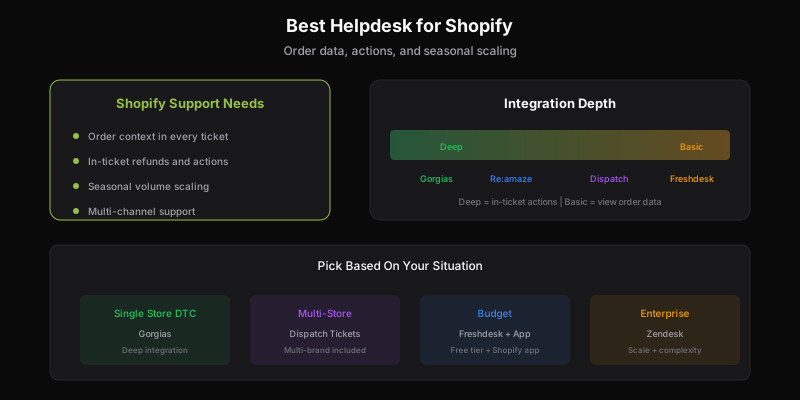
Shopify support has specific needs that generic helpdesks don’t understand.
When a customer emails “where’s my order?”, you need order data right there in the ticket—not a tab-switch to Shopify admin. When someone wants a refund, you should be able to process it without leaving the conversation. When Black Friday hits and volume spikes 5x, your helpdesk shouldn’t become a bottleneck.
I’ve helped a lot of Shopify stores set up support. Here’s what I’ve learned about which tools actually work.
What Shopify Stores Need
Order context in every ticket. This is non-negotiable. If your agents are constantly switching to Shopify admin to look up orders, you’re wasting time and making mistakes.
Action capabilities. The best integrations let you process refunds, edit orders, and update shipping directly from the ticket. Viewing is table stakes—actions are the real value.
Seasonal scaling. E-commerce volume isn’t flat. BFCM, holiday season, big promotions—you need a tool that handles spikes without breaking (or breaking the bank).
Multi-channel support. Customers reach out everywhere: email, chat, Instagram, Facebook. Centralizing these matters for e-commerce.
The Shopify Helpdesk Shortlist
Gorgias — Built for This
Gorgias is the obvious choice for a reason: it’s built specifically for e-commerce, with Shopify as the primary focus.
The integration is deep. Order history shows automatically. Agents can issue refunds, cancel orders, and create return labels without leaving the ticket. Macros can pull in order data dynamically. It’s genuinely purpose-built.
What works: Deepest Shopify integration. Actions, not just data. Built for e-commerce workflows. Macros understand your store.
What doesn’t: Expensive at volume (per-ticket pricing scales linearly). Interface can feel cramped. Limited beyond e-commerce use cases.
Pricing: Starts at $10/month for 50 tickets. $60 for 300, $360 for 2,000. Gets expensive as you grow.
Best for: Shopify stores where deep integration justifies the cost, typically DTC brands with $1M+ revenue.
Compare Gorgias Alternatives →
Re:amaze — Strong Alternative
Re:amaze is the other e-commerce-focused helpdesk worth considering. Similar concept to Gorgias—built for online stores with deep platform integrations.
The Shopify integration is solid: order data, customer history, actions like refunds and cancellations. Re:amaze also includes live chat, chatbots, and a knowledge base in all plans.
What works: Good Shopify integration. More feature-complete than Gorgias out of the box. Includes chat in all plans. Slightly different pricing model.
What doesn’t: Not quite as deep as Gorgias on Shopify-specific features. Less established in the e-commerce space.
Pricing: $29/seat/month Basic, $49/seat Pro. Volume-based options available.
Best for: Shopify stores wanting Gorgias-style integration at potentially lower cost.
Dispatch Tickets — Best for Multi-Store
Running multiple Shopify stores? This is where Dispatch Tickets stands out.
Multi-brand is included on every plan—not an enterprise upsell. Each store gets its own workspace with separate tickets, customers, and email identity. Per-ticket pricing means volume spikes don’t multiply your costs.
The Shopify integration isn’t as deep as Gorgias (no in-ticket refunds), but the economics work better for multi-store operations.
What works: Multi-brand included. Per-ticket pricing handles seasonal spikes. Unlimited users—whole team can access.
What doesn’t: Lighter Shopify integration than specialized tools. No in-ticket actions (view only currently). Newer product.
Pricing: $29/month for 1,000 tickets, unlimited users, unlimited brands.
Best for: Shopify stores running multiple storefronts or brands.
See Dispatch Tickets for e-commerce →
Zendesk — Enterprise Grade
If you’re a larger Shopify operation—enterprise, high volume, complex requirements—Zendesk handles it all. Shopify app available, though integration isn’t as native as Gorgias.
Zendesk’s strength is everything else: routing, automation, reporting, AI features, massive integration ecosystem. For sophisticated operations, the platform depth matters.
What works: Handles any scale. Sophisticated automation and AI. Huge app marketplace. Enterprise-ready.
What doesn’t: Expensive. Complex. Shopify integration is add-on, not core. Overkill for most stores.
Pricing: Suite starts at $55/agent/month.
Best for: Large Shopify operations (usually $10M+ GMV) with complex support needs.
Compare Zendesk Alternatives →
Freshdesk — Budget with Shopify App
Freshdesk offers a Shopify app in its marketplace—not as deep as Gorgias, but functional. Order data syncs, basic actions available, and Freshdesk’s core helpdesk features are solid.
The free tier (up to 10 agents) makes this attractive for smaller stores. You get real helpdesk functionality without the e-commerce premium.
What works: Free tier actually useful. Shopify app available. Full helpdesk features. Established platform.
What doesn’t: Shopify integration is add-on quality, not purpose-built. Per-agent pricing adds up. Interface getting cluttered.
Pricing: Free tier, then $15+/agent/month.
Best for: Shopify stores on a budget who need core helpdesk functionality with basic integration.
Compare Freshdesk Alternatives →
Quick Comparison
| Tool | Shopify Integration | Pricing Model | Multi-Store | Best For |
|---|---|---|---|---|
| Gorgias | Deep (actions) | Per-ticket | Add-on cost | Single-store DTC |
| Re:amaze | Good (actions) | Per-seat | Yes | Mid-market stores |
| Dispatch Tickets | Basic (view) | Per-ticket | Included | Multi-store |
| Zendesk | App (add-on) | Per-seat | Enterprise | Large operations |
| Freshdesk | App (add-on) | Per-seat | Pro tier+ | Budget-conscious |
The Integration Question
Do you need deep Shopify integration, or is “good enough” actually fine?
Deep integration (Gorgias, Re:amaze) makes sense when:
- Agents process refunds/cancellations frequently
- WISMO (“where is my order?”) is a huge ticket category
- Support team is dedicated, not cross-functional
- Ticket volume justifies the per-ticket cost
Lighter integration (Freshdesk, Zendesk, Dispatch Tickets) works when:
- Most tickets need order context but not actions
- You’re running multiple stores
- Budget is constrained
- Team is cross-functional (engineers, founders need access)
Be honest about what you actually need. Deep integration is cool, but if your agents are looking up orders for context rather than taking actions, you might be overpaying for capabilities you don’t use.
Seasonal Pricing Trap
E-commerce volume isn’t flat. Black Friday happens. Holiday season happens. Your helpdesk pricing model matters here.
Per-ticket pricing (Gorgias, Dispatch Tickets) scales with volume. Normal month: normal cost. BFCM: higher cost. This can go either way—good if you normally have low volume, painful if BFCM is a big multiple.
Per-seat pricing (Freshdesk, Zendesk, Re:amaze) is flat regardless of volume. Good for high-volume stability. But you might need to add seats for seasonal staff—and then keep paying for them.
Do the math for your situation. A store that does 500 tickets/month normally but 3,000 in December looks very different from one that does 2,000/month year-round.
My Recommendation
Single Shopify store, DTC, under $5M GMV: Gorgias or Re:amaze. The deep integration is worth it if support is a core function.
Multiple Shopify stores: Dispatch Tickets. Multi-brand pricing doesn’t multiply with storefronts.
Budget-constrained: Freshdesk free tier with Shopify app. Functional, if not exceptional.
Large/complex operation: Zendesk. It handles everything, even if it’s not e-commerce-native.
Chat-focused support: Look at Gorgias (includes chat) or add Tidio/Crisp alongside your helpdesk.
The best tool depends on your specific situation. Don’t let comparison articles tell you there’s one right answer—there isn’t.
Related
Ready to get started?
Join the waitlist and start building better customer support into your product.
Get Early AccessFrequently Asked Questions
Gorgias is purpose-built for Shopify with the deepest integration—order data, in-ticket refunds, cancellations. Re:amaze is a strong alternative. For multi-store operations, Dispatch Tickets offers better economics. For budget, Freshdesk with its Shopify app.
Yes, via marketplace app. You can view order data in tickets, but it's not as deep as Gorgias—no in-ticket refunds or order actions. Zendesk makes sense for larger Shopify operations needing enterprise features, but it's overkill for most stores.
Depends on volume. Gorgias' per-ticket pricing starts cheap ($10/mo for 50 tickets) but scales quickly. For stores under 200 tickets/month, it's reasonable. Above that, calculate costs carefully—alternatives may be cheaper at volume.
Dispatch Tickets includes multi-brand on all plans at $29/month flat. Gorgias charges extra for multi-store. Re:amaze supports it but per-seat pricing adds up. For agencies or multi-brand operations, multi-store economics matter a lot.