Hidden Cost of Per-Agent Pricing
Per-seat pricing doesn't just affect your budget—it shapes behavior, limits collaboration, and creates perverse incentives. Here's what it's really costing you.
When you evaluate helpdesk software, the pricing looks simple: $50-150 per agent per month. You count your support agents, multiply, and budget accordingly.
But that number on the pricing page is a fraction of what per-seat pricing actually costs your organization. The real costs are hidden in workarounds, limited access, and behavioral changes that accumulate over time.
The Obvious Costs
Let’s start with what you can see on the invoice. (For a broader comparison of pricing models, see our guide on per-ticket vs per-seat pricing.)
A typical per-seat pricing structure looks like this:
- Basic tier: $19-49/agent/month
- Pro tier: $49-79/agent/month
- Enterprise tier: $99-150/agent/month
For a team of 10 support agents on a Pro tier, that’s $490-790/month, or $5,880-$9,480/year.
This seems manageable. But who needs access?
Your 10 support agents definitely need seats. But what about:
- The 3 engineers who handle escalated bugs?
- The 2 product managers who need to see feature requests?
- The founder who wants to stay connected to customers?
- The operations person who handles shipping issues?
- The marketing manager who monitors sentiment?
- The sales reps who want context on their accounts?
Suddenly you’re not buying 10 seats—you’re buying 20+. Your $9,480/year just became $18,960/year, and you haven’t added a single support agent.
The Hidden Behavioral Costs
The invoice doesn’t capture the behavioral changes that per-seat pricing creates. These are the real costs.
1. Shared Login Syndrome
When seats are expensive, people share them. “Just use the team login.” “Here’s the credentials for the support account.”
This creates problems:
- No accountability: Who responded to this ticket? The account doesn’t say.
- No personalization: Customers talk to “Support” instead of people.
- Security risk: Multiple people knowing credentials, no individual access control.
- Audit nightmare: For compliance purposes, you can’t track who did what.
Companies don’t share logins because they want to—they do it because the alternative is paying an extra $1,000/year per person who occasionally needs to see tickets.
2. The “Ask Support to Check” Tax
When engineers can’t access support directly, they ask support agents to check things for them. “Can you see if customer X has reported this before?” “What exactly did they say the error was?” “Can you send me the screenshot they attached?”
This seems minor, but it adds up:
- Support agent time: Each lookup interrupts their flow and takes 5-10 minutes.
- Wait time: Engineers waiting for responses instead of investigating directly.
- Information degradation: The agent’s summary is never as good as the original.
If your support team handles 50 of these requests per week, and each takes 10 minutes, that’s 8+ hours of support capacity—a full day—lost to being a human proxy server.
3. Delayed Bug Identification
When engineers don’t see support tickets, bugs hide longer. The feedback loop that should be hours becomes days or weeks.
Support agent sees a bug report → Tags it → Files an internal ticket → Waits for prioritization → Engineer eventually picks it up → Asks for more context → Support finds the original ticket → Engineer finally understands the issue
Compare this to when engineers have direct access:
Engineer notices bug-tagged tickets in their filtered view → Reads original report → Diagnoses immediately → Ships fix
The difference isn’t just speed—it’s whether the bug gets fixed before it affects more customers.
4. Limited Visibility = Limited Empathy
Per-seat pricing limits who can see customer conversations. When access is rationed, most of the company operates without direct customer context.
Product decisions get made based on summaries and reports instead of raw customer voice. Engineering prioritizes based on abstract severity labels instead of understanding real impact. Leadership loses touch with what customers actually experience.
This empathy deficit compounds over time. Teams that don’t see customers start to dismiss customer concerns. “Edge case.” “User error.” “Low priority.”
5. Feature Request Telephone
A customer suggests a feature. Support logs it somewhere—maybe a spreadsheet, maybe a separate feedback tool. Product eventually sees a sanitized list. The original context, the customer’s exact words, the urgency in their request—all lost in translation.
When product managers have direct access to support, they can read feature requests in context. They see what problem the customer was solving, what they tried first, what the impact would be. This leads to better product decisions.
The Multi-Brand Multiplier
Per-seat pricing gets worse with multi-brand setups. If you support three brands, you might need different agent assignments for each. Your 10 agents might be:
- 4 for Brand A
- 4 for Brand B
- 2 shared across both
But the pricing doesn’t care. You’re buying 10 seats regardless of how work is distributed. And if Brand C launches, you need new agents even if your total ticket volume hasn’t increased—because the existing team can’t context-switch between three sets of brand voice, products, and policies.
The cost scales with organizational complexity, not actual support workload.
The Seasonal Trap
Support volume is rarely constant. E-commerce companies see Black Friday spikes. SaaS companies see end-of-quarter rushes. Product launches create temporary surges.
Per-seat pricing assumes a static team. When volume spikes:
Option 1: Understaffed spikes. You maintain your normal team and accept degraded service during busy periods. Response times balloon. CSAT drops. Customers leave.
Option 2: Overstaffed baseline. You size your team for peak volume and pay for seats that are underutilized most of the year. Your $9,480/year becomes $14,000/year for capacity you use two months annually.
Option 3: Constant churn. You add and remove seats as volume fluctuates, dealing with the onboarding overhead and the friction of adjusting contracts monthly.
None of these are good options. They’re all artifacts of a pricing model that doesn’t align with how support actually works.
Quantifying the Hidden Costs
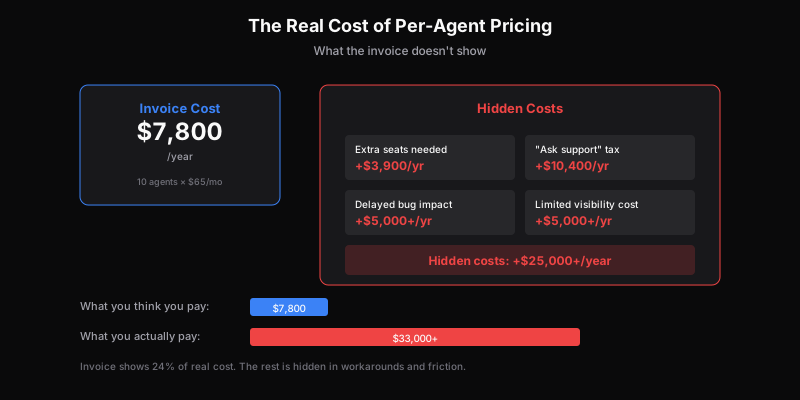
Let’s estimate the real cost for a hypothetical company with 10 support agents on a Pro plan:
Invoice cost: 10 seats × $65/month = $650/month = $7,800/year
Hidden costs:
| Cost | Calculation | Annual Impact |
|---|---|---|
| Additional seats needed (5 non-support users) | 5 × $65 × 12 | $3,900 |
| ”Ask Support to Check” tax (8 hrs/week of agent time) | 8 hrs × 52 weeks × $25/hr | $10,400 |
| Delayed bug impact (estimated customer churn) | Varies | $5,000+ |
| Information loss (poor decisions from limited access) | Varies | $5,000+ |
| Shared login security risk | Audit/compliance cost | $1,000+ |
Real cost: $33,000+/year vs. $7,800 invoice cost
The invoice shows 24% of the actual cost. The rest is hidden in workarounds, inefficiency, and organizational friction.
When Per-Seat Makes Sense
To be fair, per-seat pricing isn’t always wrong. It works well when:
- Everyone who needs access is a full-time support agent. If you have 10 agents and only 10 people ever touch support, the model fits.
- Your organization is simple. Single brand, single product, stable volume.
- You don’t need cross-functional visibility. Engineers use their own bug tracking. Product uses their own feedback tools. Support is isolated.
These conditions are rare in modern companies, especially in SaaS and e-commerce where support intersects with engineering, product, and operations constantly.
The Alternative: Volume-Based Pricing
The alternative to per-seat is per-ticket or volume-based pricing. Instead of paying for how many people can access the system, you pay for how much support you do. (This is a key reason why many teams look for Zendesk alternatives or Freshdesk alternatives.)
- Pay based on ticket volume
- Unlimited users included
- Costs scale with actual support workload
A company handling 2,000 tickets/month might pay $99/month flat, regardless of whether 5 people or 50 people have access.
The economics change completely:
- Engineers can have access—no incremental cost
- Product can have access—no incremental cost
- Founders can have access—no incremental cost
- Seasonal spikes don’t require adding seats
- Multi-brand doesn’t multiply costs
Calculating Your Real Cost
To understand what per-seat pricing is really costing you:
Step 1: Count Total Access Needs
List everyone who needs to see support tickets:
- Support agents (obvious)
- Support managers
- Engineers (especially for bug escalations)
- Product managers (for feature feedback)
- Operations (for fulfillment issues)
- Sales (for account context)
- Marketing (for sentiment monitoring)
- Leadership (for customer pulse)
Step 2: Calculate the Seat Gap
Compare your list to how many seats you have. The gap tells you who’s working around the system.
Step 3: Estimate Workaround Costs
For each person without access, estimate:
- How often do they need information from support?
- How long do those requests take (their time + support agent time)?
- What’s the cost of delays and information loss?
Step 4: Add the Behavioral Costs
Consider:
- Bugs that hide because engineers can’t see support
- Feature decisions made without customer context
- Cross-team friction from information silos
Step 5: Compare to Volume-Based Alternatives
Calculate what you’d pay with per-ticket pricing. Factor in:
- All users having access
- No workaround costs
- No behavioral costs
- Scaling with volume, not headcount
Making the Switch
If you’re currently on per-seat pricing and the hidden costs are significant, switching models requires some calculation:
-
Know your volume: How many tickets per month? This determines volume-based pricing.
-
Know your access needs: How many people should have access? This determines the value of unlimited users.
-
Know your growth trajectory: Will you add more support agents, or more ticket volume? The answer determines which model scales better.
-
Know your seasonal pattern: Do you have predictable spikes? Volume-based pricing handles these without seat changes.
For most companies with cross-functional access needs, multi-brand complexity, or seasonal variation, volume-based pricing costs less and creates fewer organizational distortions.
The Bottom Line
Per-seat helpdesk pricing creates perverse incentives. It limits access, encourages workarounds, and distorts behavior—all to manage a cost structure that doesn’t align with how support actually works.
The price you see on the invoice is often 25-50% of the real cost. The rest is hidden in inefficiency, limited access, and organizational friction.
Before accepting per-seat as the only option, calculate what it’s really costing you. The number might make volume-based alternatives look very attractive.
Dispatch Tickets uses per-ticket pricing with unlimited users included. Everyone who needs access can have it—engineers, PMs, founders—without incrementing your bill. See how much you could save with pricing that matches how support actually works.
Ready to get started?
Join the waitlist and start building better customer support into your product.
Get Early AccessFrequently Asked Questions
Beyond the invoice, hidden costs include: additional seats for non-support users (engineers, PMs, founders), the 'ask support to check' tax (support agents serving as proxies for others), delayed bug identification from limited engineering access, reduced empathy from restricted visibility, and seasonal staffing challenges. These often exceed the visible cost by 3-4x.
Start with your invoice cost, then add: (1) seats needed for people currently without access, (2) time cost of information requests (estimate hours/week × hourly rate), (3) estimated impact of delayed bugs and limited visibility, and (4) cost of workarounds like shared logins. The true cost is typically 3-4x the invoice.
Per-seat works when: everyone who needs access is a full-time support agent, your organization is simple (single brand, stable volume), and you don't need cross-functional visibility. These conditions are rare in modern SaaS and e-commerce where support intersects constantly with engineering, product, and operations.
Per-ticket or volume-based pricing charges based on support workload rather than headcount. This means unlimited users can have access—engineers, PMs, founders—without incrementing your bill. Costs scale with actual support volume, and seasonal spikes don't require adding seats.