Zendesk Alternatives for Startups
Zendesk is overkill for early-stage startups. Compare alternatives that match startup budgets, speed, and simplicity needs.
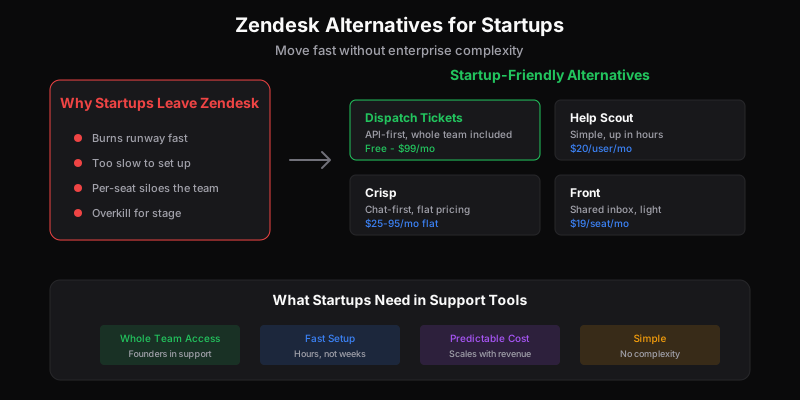
Zendesk makes sense at scale. At 50+ agents with complex workflows, the investment pays off. But for a startup with 2-10 people? You’re paying enterprise prices to use 10% of the features.
Early-stage startups need support software that:
- Sets up in hours, not weeks
- Costs less than an employee’s lunch budget
- Lets founders stay close to customers
- Doesn’t punish you for adding team members
Here’s what actually works.
Why Startups Shouldn’t Start with Zendesk
1. You Can’t Afford It
At $55/agent/month for Suite Team, a 5-person startup pays $275/month. That’s $3,300/year for help desk software—before you even know if your product has market fit.
And $55 is the starter tier. Need custom reports or multiple SLAs? That’s $89/agent. Need sandbox environments or advanced AI? $115/agent.
2. It’s Too Complex
Zendesk is designed for support teams with dedicated administrators. Startups don’t have that. The founder handles support between investor calls and product decisions.
Every hour spent configuring Zendesk is an hour not spent with customers or building product.
3. Per-Seat Pricing Kills Collaboration
Startups thrive when everyone touches customer feedback. Engineers should see bug reports. PMs should read feature requests. Founders should feel customer pain directly.
At $55/seat, that collaboration becomes a budget discussion. Most startups end up with:
- One person siloed on support
- Secondhand customer feedback
- Lost context in handoffs
Best Zendesk Alternatives for Startups
1. Help Scout — Best for Customer Intimacy
Why it works: Help Scout keeps you close to customers. The interface feels like email, setup takes hours, and the focus is on conversations rather than tickets.
Pricing: $20/user/month (Standard), $40/user/month (Plus)
Startup fit:
- Up and running in an afternoon
- Feels personal, not corporate
- Great Docs for knowledge base
- Beacon widget for in-app support
Watch out for:
- Per-user pricing (still adds up)
- Multi-brand needs Plus ($40/user)
- Limited API for custom integrations
Best for: B2C startups where customer relationships matter more than ticket throughput.
2. Dispatch Tickets — Best for Technical Startups
Why it works: Built API-first for startups that want support embedded in their product, not bolted on. Per-ticket pricing means your whole team—engineers, PMs, founders—can see customer feedback without per-seat costs.
Pricing: Free (100 tickets/month), $29/month (1,000 tickets), $99/month (10,000 tickets)
Startup fit:
- Unlimited users on all plans
- API-first (embed support in your product)
- Multi-brand included (for pivots or multiple products)
- Open source portal (customize everything)
- Whole team can participate
Watch out for:
- Newer product (launched 2026)
- Smaller integration ecosystem
- No phone channel yet
Best for: SaaS startups, developer tools, API products—anywhere the team is technical and wants flexibility.
3. Freshdesk — Best for Growing Into
Why it works: Freshdesk has a free tier for 10 agents. That’s enough to get started, validate your support needs, and grow into paid tiers when you need them.
Pricing: Free (10 agents), $15/agent (Growth), $49/agent (Pro)
Startup fit:
- Free tier for early days
- Room to grow without switching
- Familiar Zendesk-like interface
- Good automation once you need it
Watch out for:
- Per-agent pricing kicks in at scale
- Features locked to expensive tiers
- Growing complex like Zendesk
Best for: Startups that expect rapid growth and want to avoid switching tools later.
4. Crisp — Best for Chat-First
Why it works: If your startup’s support is mostly live chat, Crisp bundles chat, basic ticketing, and a shared inbox for a flat monthly price.
Pricing: Free (2 seats), $25/month (4 seats), $95/month (unlimited seats)
Startup fit:
- Flat pricing, not per-seat
- Chat + email in one place
- Simple and fast to set up
- Good for real-time support
Watch out for:
- Chat-centric (ticketing is basic)
- Less suited for email-heavy support
- Fewer enterprise integrations
Best for: Consumer startups with high chat volume—apps, marketplaces, social products.
5. Front — Best for Shared Inbox
Why it works: If your startup’s support is mostly email and you want to collaborate without full ticketing, Front adds team features on top of your existing inbox.
Pricing: $19/seat/month (Starter), $59/seat (Growth)
Startup fit:
- Works with existing email
- Collaboration without complexity
- Good for teams that aren’t “support teams”
- Fast setup
Watch out for:
- Per-seat pricing
- Not a full ticketing system
- Limited for high-volume support
Best for: Startups where support is handled by the whole team (not a dedicated function) and email is the primary channel.
Comparison Table
| Tool | Starting Price | Unlimited Users? | Setup Time | API Quality | Best For |
|---|---|---|---|---|---|
| Help Scout | $20/user | No | Hours | Basic | Customer intimacy |
| Dispatch Tickets | Free | Yes | Hours | Excellent | Technical startups |
| Freshdesk | Free | No (10 agents) | Days | Good | Growing into |
| Crisp | Free | No (2 seats) | Hours | Good | Chat-first |
| Front | $19/seat | No | Hours | Good | Shared inbox |
When You Don’t Need Help Desk Software Yet
Many early-stage startups don’t need dedicated support software. You might be fine with:
Gmail + labels — Works until you have multiple people responding or need tracking.
Notion + Tally forms — Basic ticket tracking with a form. Manual but free.
Intercom (chat only) — If you just need a chat widget, the basic tier works.
Signs you’ve outgrown these:
- Customers ask “what happened to my request?”
- Multiple people respond to the same ticket
- You can’t tell what’s open vs. resolved
- Important issues fall through cracks
Founder Support Is a Feature
At the early stage, founders handling support is an advantage, not a limitation. You get:
- Unfiltered customer feedback
- Deep understanding of pain points
- Stories for fundraising
- Product direction clarity
The right tool keeps you close to customers. The wrong tool creates distance through complexity.
The Bottom Line
Pre-seed / no revenue: Freshdesk free tier, or just use Gmail Seed stage: Help Scout, Dispatch Tickets, or Crisp depending on channel Series A: Evaluate based on actual needs, not hypothetical scale
Most startups that “grow into Zendesk” would be better served by simpler tools forever. Don’t optimize for scale you don’t have.
Related
Ready to get started?
Join the waitlist and start building better customer support into your product.
Get Early AccessFrequently Asked Questions
Start simple. Help Scout or Dispatch Tickets let you respond to customers in hours, not weeks. Avoid complex tools like Zendesk early—you can always upgrade later. Focus on tools that let founders stay close to customers.
Yes, especially early on. Direct customer contact provides invaluable product insights. Per-seat pricing tools discourage this by making it expensive to include founders. Per-ticket pricing (like Dispatch Tickets) avoids this problem.
Consider switching if: per-seat costs are limiting who can see customer feedback, setup complexity is slowing you down, you're paying for features you don't use, or multi-brand pricing is blocking your growth.
Migration typically takes 1-2 weeks for startups with moderate ticket history. Most alternatives have Zendesk importers. The bigger challenge is rebuilding automations and workflows, which early-stage startups often haven't heavily customized.