Intercom Alternatives (2026)
Intercom's pricing is unpredictable and expensive at scale. These alternatives offer messaging, support, or both—without the sticker shock.
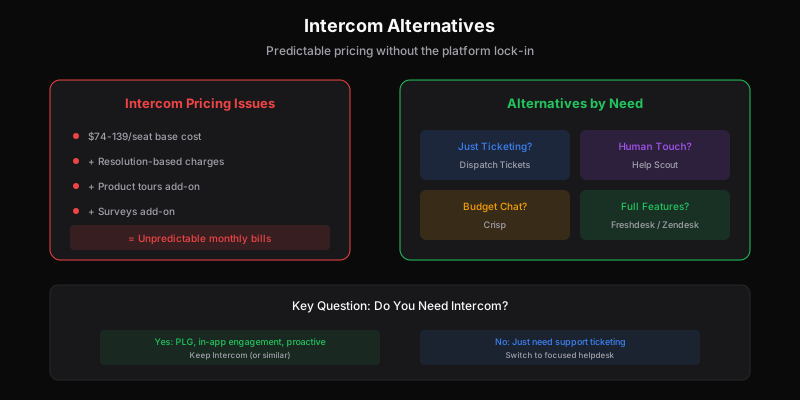
Intercom is powerful. It combines messaging, support, marketing, and product tours into one platform. For product-led SaaS companies, it’s become the default choice.
But Intercom’s pricing has become a common pain point. What starts as a reasonable cost grows unpredictably as you scale—and by the time you realize it, you’re locked in.
Why Teams Look for Intercom Alternatives
1. Pricing Complexity
Intercom’s pricing is notoriously hard to predict:
- Base seat costs: $74-139/seat/month
- Resolution-based pricing: Pay per resolved conversation
- Add-ons: Product tours, surveys, and advanced features cost extra
- Usage tiers: Costs scale with contacts, messages, and resolutions
A company that budgeted $500/month can easily hit $2,000+ as they scale. The resolution-based model means costs fluctuate month to month.
2. Feature Bundling
Intercom wants you using everything—messaging, support, marketing, tours. If you only need support ticketing, you’re paying for capabilities you won’t use.
- Need just a helpdesk? You’re buying a customer engagement platform.
- Want chat without the product tours? Still bundled.
- Simple ticketing? That’s not really Intercom’s focus.
3. Overwhelming for Simple Needs
Intercom does a lot. For teams that need focused functionality:
- Setup takes days, not hours
- Configuration requires planning
- The interface can feel busy
- Simple workflows need complex setup
If your support model is straightforward, Intercom’s power becomes overhead.
4. Support Quality at Lower Tiers
Like many support tools, Intercom’s own support varies by tier. Lower-tier customers report longer response times and less helpful answers.
The Best Intercom Alternatives
1. Dispatch Tickets — Best for API-First Support
If you need ticketing without the engagement platform, Dispatch Tickets offers focused simplicity.
Why choose it:
- Per-ticket pricing — Predictable costs, no seat fees
- API-first — Built for integration, not engagement
- Unlimited users — Engineers, PMs, founders included
- Multi-brand — Native workspace separation
Pricing: $29/month for 1,000 tickets, unlimited users.
Best for: Technical teams that want support infrastructure without a platform.
Trade-off: No live chat, product tours, or marketing automation. It’s ticketing, done well.
Learn more about Dispatch Tickets →
2. Help Scout — Best for Human-Centered Support
If you like Intercom’s conversational feel but want simpler pricing, Help Scout delivers warmth without complexity.
Why choose it:
- Conversations, not tickets — Feels personal
- Beacon widget — In-app help without full platform
- Simple pricing — Per-user, predictable
- Knowledge base included — Docs is excellent
Pricing:
- Standard: $20/user/month
- Plus: $40/user/month
- Pro: $65/user/month
Best for: Teams that value customer relationships over automation.
Trade-off: Per-user pricing limits access. Less powerful than Intercom for engagement.
Compare: Help Scout Alternatives →
3. Crisp — Best Budget Chat Alternative
If Intercom’s chat is what you need but the price isn’t, Crisp offers similar functionality at a fraction of the cost.
Why choose it:
- Live chat included — Core feature, not add-on
- Chatbots — Automation without complexity
- Shared inbox — Team collaboration
- Affordable — Dramatically cheaper than Intercom
Pricing:
- Free: Basic features
- Pro: $25/workspace/month (4 seats included)
- Unlimited: $95/workspace/month (20 seats included)
Best for: Startups wanting Intercom-style chat without Intercom pricing.
Trade-off: Less sophisticated than Intercom. Smaller ecosystem.
4. Freshdesk — Best Full-Featured Alternative
If you need comprehensive support features without Intercom’s engagement focus, Freshdesk delivers.
Why choose it:
- Complete helpdesk — Ticketing, chat, phone, knowledge base
- Freshchat add-on — Modern messaging if you need it
- Mature platform — Years of development
- Better free tier — Actually usable
Pricing:
- Free: Up to 10 agents
- Growth: $15/agent/month
- Pro: $49/agent/month
- Enterprise: $79/agent/month
Best for: Teams wanting comprehensive features with traditional helpdesk structure.
Trade-off: Per-agent pricing adds up. Gets expensive at scale.
Compare: Freshdesk Alternatives →
5. Zendesk — Best Enterprise Alternative
If you’re leaving Intercom because you’ve outgrown it, Zendesk offers enterprise-grade support.
Why choose it:
- Enterprise scale — Proven at massive volume
- Full omnichannel — Every channel in one place
- Mature ecosystem — Integrations for everything
- Support focus — Not trying to be an engagement platform
Pricing:
- Team: $55/agent/month
- Growth: $89/agent/month
- Professional: $115/agent/month
Best for: Large teams needing enterprise support features.
Trade-off: Complex, expensive, steep learning curve. The per-seat pricing limits cross-functional access.
Compare: Zendesk Alternatives →
Quick Comparison
| Tool | Starting Price | Pricing Model | Live Chat | Best For |
|---|---|---|---|---|
| Intercom | $74/seat | Per-seat + usage | Yes | PLG engagement |
| Dispatch Tickets | $29/mo | Per-ticket | No | API-first ticketing |
| Help Scout | $20/user | Per-user | Beacon | Relationship support |
| Crisp | Free | Per-workspace | Yes | Budget chat |
| Freshdesk | Free | Per-agent | Add-on | Full-featured helpdesk |
| Zendesk | $55/agent | Per-agent | Add-on | Enterprise support |
Intercom vs. Helpdesk: Different Tools
The key question isn’t “which Intercom alternative?” It’s “do I need Intercom?”
Choose Intercom-style tools (Intercom, Crisp) if:
- Live chat is primary channel
- You want proactive engagement (product tours, onboarding)
- In-app messaging matters more than email
- You’re product-led growth
Choose helpdesk tools (Zendesk, Freshdesk, Dispatch Tickets) if:
- Email is primary channel
- You need ticket lifecycle management
- SLAs and routing matter
- Support is reactive, not proactive
Many teams use both—Intercom for in-app engagement, a helpdesk for ticket management. The question is whether bundling them saves or costs more.
When to Stay on Intercom
Intercom isn’t wrong for everyone:
- Product-led SaaS — If in-app engagement drives growth, Intercom’s integration is valuable
- Sales + support combined — The unified view helps handoffs
- Heavy chat usage — If most support is synchronous messaging
- Already invested — Migration costs may exceed savings
The cost is worth it when you’re using the full platform. The problem is paying platform prices for point-solution needs.
Migration Considerations
Moving from Intercom:
- Export conversation history — Intercom allows data export
- Map your workflows — What automations need recreation?
- Decide on chat — Will you still have live chat? What tool?
- Update your widget — The Messenger needs replacement
- Train team — Different interface, different patterns
The hardest part is often replacing the Messenger. If customers expect chat, you need a chat solution—even if ticketing moves elsewhere.
The Bottom Line
Intercom is powerful but expensive and complex. The right alternative depends on what you actually need:
- Just ticketing → Dispatch Tickets
- Warm, human support → Help Scout
- Budget chat → Crisp
- Full-featured helpdesk → Freshdesk
- Enterprise scale → Zendesk
Most teams leaving Intercom are escaping the pricing model, not the features. Choose based on what functionality you’ll actually use—not what seemed useful when you signed up.
Related
Ready to get started?
Join the waitlist and start building better customer support into your product.
Get Early AccessFrequently Asked Questions
Intercom uses complex pricing: base seat costs ($74-139/seat), plus resolution-based charges, plus add-ons for product tours and surveys. Costs scale unpredictably—companies often see bills 2-4x what they expected as they grow.
For chat: Crisp starts free and $25/workspace for Pro. For ticketing: Freshdesk has a free tier, Dispatch Tickets starts at $29/month with unlimited users. Help Scout offers similar warmth at $20/user with simpler pricing.
Not necessarily. Intercom is a customer engagement platform—great for in-app messaging, product tours, and proactive outreach. If you mainly need support ticketing, dedicated helpdesks (Zendesk, Freshdesk, Dispatch Tickets) are simpler and cheaper.
Depends on your model: Crisp for budget chat needs, Help Scout for relationship-focused support, Dispatch Tickets for API-first technical teams, or Freshdesk for full-featured helpdesk. Intercom remains good if you heavily use proactive engagement.