Groove Alternatives (2026)
Groove promised simplicity but development slowed. Here are alternatives that deliver on the 'simple helpdesk' promise.
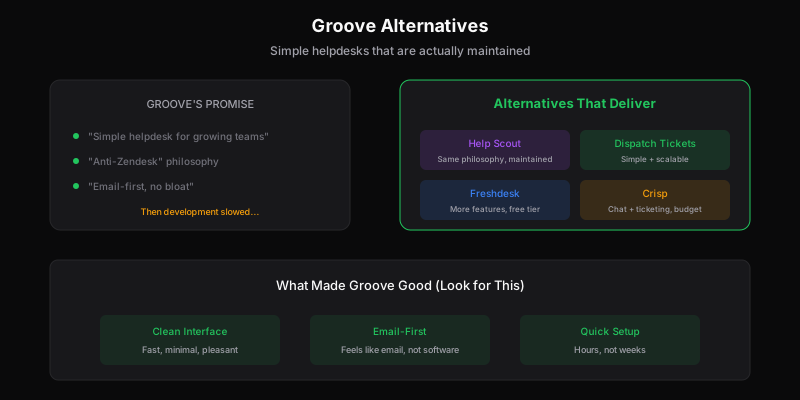
Groove made a name for itself as the anti-Zendesk—simple, focused, no bloat. For a while, that pitch really worked.
Then things got quiet. Feature updates slowed. The product that was supposed to stay simple started feeling neglected rather than intentionally minimal. And a lot of teams started wondering: is there something better?
If you’re one of them, here’s what I’ve found.
Why Groove Users Start Looking
The “simple” became “limited.” There’s a difference between intentionally minimal and just… not having features. Groove crossed that line for many teams. Things that should be table stakes—decent reporting, flexible automation, mobile support—never really arrived.
Development feels abandoned. Groove’s blog used to be legendary in SaaS circles. The company was vocal about their journey, their metrics, their product philosophy. That energy disappeared. Updates are rare. Communication is sparse. It’s hard to bet on a product that feels like it’s on maintenance mode.
Pricing crept up. Groove started as the affordable option. Prices increased while the product stayed mostly the same. Now you’re paying more than you used to for a tool that does less than competitors.
The team outgrew it. Groove was perfect when you had 2-3 people doing support. At 10+ agents with real volume, the cracks show. No SLA tracking. Limited workflow automation. Basic reporting. What felt lean at small scale feels incomplete at medium scale.
What Groove Got Right (And What to Look For)
Before we trash Groove completely—it did some things really well:
- Clean, fast interface. Using Groove was pleasant. Everything loaded quickly. No visual clutter.
- Email-first approach. It felt like email, not enterprise software. Customers never knew they were in a “ticketing system.”
- Easy setup. You could be productive in hours, not weeks.
When evaluating alternatives, look for tools that preserve these qualities. Don’t trade simplicity for a feature list you’ll never use.
Alternatives That Actually Deliver
Help Scout — The Spiritual Successor
Help Scout is basically what Groove promised to be, but maintained. Clean interface, email-first, deliberately simple—and actively developed.
Help Scout has the same philosophy (support should feel human, not robotic) but with a team that ships regular updates and clearly cares about the product. Their knowledge base (Docs) is excellent. Beacon provides help widget functionality.
Pricing: $20/user/month Standard, $40/user Plus.
Why it fits: Same values, better execution. If you liked Groove’s approach, you’ll feel at home.
The trade-off: Still per-user pricing. Still light on advanced features. If you outgrew Groove’s capabilities, you might outgrow Help Scout too.
Compare Help Scout Alternatives →
Dispatch Tickets — For Growing Teams
If you loved Groove’s simplicity but need room to grow, Dispatch Tickets offers a different model. API-first design means it’s both simple to start and extensible when you need more.
Per-ticket pricing means you’re not penalized for having more people access support (engineers, product managers, founders can all see tickets without extra cost). Multi-brand support is built in, not an upsell.
Pricing: $29/month for 1,000 tickets, unlimited users.
Why it fits: Scales without getting complicated. Pricing rewards efficiency, not headcount reduction.
The trade-off: Newer product. Smaller company. Less hand-holding than established players.
See Dispatch Tickets pricing →
Freshdesk — When You Need More Features
If you’re leaving Groove because it’s too limited, Freshdesk is a solid upgrade. It has pretty much every feature you could want, with a free tier that’s genuinely useful.
Freshdesk’s Growth plan ($15/agent) covers most needs: automation, basic SLA tracking, customer portal. The interface is clean enough, though not as minimal as Groove.
Pricing: Free tier available. Paid from $15/agent/month.
Why it fits: Feature-complete without being overwhelming. Good middle ground between simple and enterprise.
The trade-off: More complex than Groove by design. Per-seat pricing adds up as you grow.
Compare Freshdesk Alternatives →
Crisp — Budget-Friendly With Chat
If live chat matters to you (Groove’s chat was limited), Crisp offers solid chat plus ticketing at an aggressive price point.
Crisp’s pricing model is different: per-workspace, not per-user. $25/month gets you a workspace with 4 seats included. That’s a good deal for small teams who need chat capability.
Pricing: Free tier, Pro at $25/workspace/month.
Why it fits: If you need chat more than advanced ticketing, Crisp delivers value.
The trade-off: Less mature than the big players. Ticketing features are basic compared to dedicated helpdesks.
Front — If Collaboration Is Key
Front isn’t really a helpdesk—it’s a shared inbox with collaboration features. But if what you loved about Groove was the “feels like email” experience, Front takes that further.
Front is built for teams that communicate in email and need to collaborate on responses. Comments, assignments, shared drafts—all in a familiar email interface.
Pricing: $19/user/month Starter, scales up from there.
Why it fits: Email-native experience. Great for teams where multiple people weigh in on responses.
The trade-off: Not a helpdesk. No ticket statuses, no SLA tracking, no customer portal. You’re trading features for collaboration.
Quick Comparison
| Tool | Price | Philosophy | Best For |
|---|---|---|---|
| Groove | $16+/user | Simple helpdesk | Small teams (stagnant) |
| Help Scout | $20/user | Human support | Teams valuing simplicity |
| Dispatch Tickets | $29/mo flat | API-first | Growing technical teams |
| Freshdesk | Free+ | Full-featured | Teams needing capabilities |
| Crisp | $25/workspace | Chat-first | Chat-heavy support |
| Front | $19/user | Email collaboration | Team-based responses |
Making the Switch
Groove migration is usually straightforward:
- Export conversations. Groove lets you export your data. Get it before you cancel.
- Move your knowledge base. If you used Groove’s KB, export the content. Most alternatives can import it, though you’ll likely need to clean up formatting.
- Recreate rules. Groove’s automation was limited, so this shouldn’t take long. Document what you had before rebuilding.
- Update your email forwarding. Once the new tool is ready, point your support email there.
The technical migration is easy. The muscle memory takes longer—expect a week or two before your team feels fully comfortable.
The Real Question
Here’s what I’d ask if you’re considering leaving Groove: what changed?
If Groove worked fine and you’re just curious, maybe stay put. Switching costs are real—time, learning, potential disruption.
But if you’re frustrated—if tickets are falling through, if your team complains about the tool daily, if you’re paying for something that doesn’t feel maintained—then yes, better options exist.
The helpdesk market has gotten competitive. Tools that are actively developed, reasonably priced, and actually pleasant to use aren’t rare anymore. You have choices.
Related
Ready to get started?
Join the waitlist and start building better customer support into your product.
Get Early AccessFrequently Asked Questions
Groove went quiet. The company that was once vocal about their journey and product philosophy stopped shipping major updates. Development slowed, communication became sparse, and the product that promised simplicity started feeling abandoned rather than intentionally minimal.
Barely. Updates are rare, and the product hasn't evolved meaningfully in years. For teams betting on their helpdesk long-term, this lack of development is a risk. Alternatives like Help Scout offer similar philosophy with active maintenance.
Help Scout is the closest match—same simple, email-first philosophy but with active development and clear product investment. If you liked Groove's approach, Help Scout delivers on that promise better.
If Groove still works for you, switching has costs. But if you're frustrated by limitations or concerned about the product's future, better options exist. The market has evolved—simple, well-maintained helpdesks are no longer rare.