Why Startups Should Avoid Per-Seat
Per-seat pricing punishes the exact behaviors that make early-stage startups successful. Here's why the model is broken for growing teams.
At a startup, everyone does support. The founder replies to that first angry customer. Engineers jump into bug reports. Product managers field feature requests. The lines between roles blur because they have to.
This is how great products get built. Direct customer contact creates tight feedback loops. Problems get fixed fast because the people who can fix them are the ones hearing about them.
Per-seat support pricing punishes exactly this behavior.
The Startup Support Reality
In the first two years of most startups, support looks something like this:
Pre-seed (1-3 people): Founders handle everything. One shared inbox, maybe a simple help desk. Costs are minimal because there’s no team to pay for.
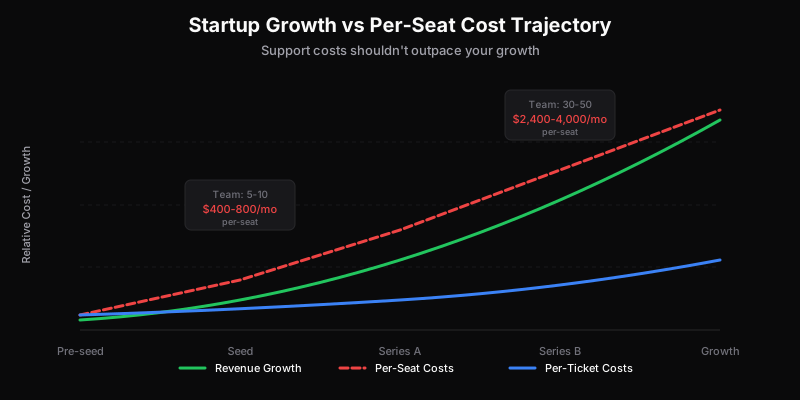
Seed (4-10 people): Now it gets interesting. You have engineers who need to see bug reports. A product person who wants to track feature requests. Maybe a part-time support hire. Suddenly 5-6 people need access to customer conversations.
Series A (10-30 people): Support volume is real now. You might have 1-2 dedicated support people, but engineers still handle escalations, product still monitors feedback, and leadership still jumps in for key accounts. That’s 10-15 people who need access.
Series B and beyond (30-100+ people): You have a support team, but the cross-functional need hasn’t gone away. Success managers, sales engineers, QA, regional leads—the list grows.
Here’s the problem: per-seat pricing scales linearly with headcount, while ticket volume often doesn’t.
The Math That Doesn’t Work
Let’s say you’re a Series A SaaS startup:
- 20 employees
- 10 of them occasionally need support access
- 800 tickets per month
Per-seat pricing ($79/seat):
- 10 seats: $790/month
- Cost per ticket: $0.99
Per-ticket pricing ($99/month for 1,000 tickets):
- Flat fee: $99/month
- All 10 users included
- Cost per ticket: $0.12
You’re paying 8x more for the same outcome.
But it gets worse. The per-seat model creates pressure to restrict access, which means the people who should be seeing customer feedback… aren’t. And that has second-order effects that hurt far more than the software bill.
What Restricted Access Actually Costs
When you limit support access to “only the people who really need it,” you introduce friction:
Engineers don’t see bug reports directly. They hear about them secondhand, filtered through whoever has support access. Context gets lost. Reproduction steps get garbled. What should be a 5-minute fix turns into a game of telephone.
Product managers miss the signal. Feature requests show up in support, but product only sees the ones someone thought to forward. The quiet patterns—the five customers who all mentioned the same friction point—never surface because no one connected the dots.
Founders lose touch. The direct line to customers that defined your early days gets mediated by whoever has seats. The feedback that should be shaping strategy arrives as a summary in a weekly report.
For more on how these hidden costs compound, see our breakdown of how to calculate your true cost per ticket.
The “Light User” Problem
Per-seat pricing assumes everyone who needs access uses the system the same way. But in a startup, usage is wildly uneven:
- Your support lead handles 200 tickets/month
- Your senior engineer handles 15 technical escalations
- Your CEO checks in on VIP issues maybe 5x/month
Under per-seat pricing, all three pay the same. The engineer’s 15 tickets cost $79. The CEO’s 5 interactions cost $79. You’re paying full price for occasional access.
The alternative—not giving them access—is worse. Shared logins create security and accountability problems. Relaying information through gatekeepers slows everything down. People stop paying attention to support because the friction isn’t worth it.
Why Per-Ticket Works for Startups
Per-ticket pricing flips the model:
Everyone gets access. No decisions about who “deserves” a seat. The intern can read tickets. The CEO can check on key accounts. Engineers can see their bugs.
Costs track usage, not headcount. Hire 5 more people? Your support software bill doesn’t change. Only ticket volume affects cost—and ticket volume actually correlates with business activity.
No artificial barriers. When access is free, you default to transparency. Information flows to the people who can act on it.
This isn’t just about saving money (though the savings are significant). It’s about preserving the information flow that makes startups work.
When Per-Seat Might Make Sense
To be fair, per-seat can work if:
- You have a dedicated support team and no one else needs access
- Your ticket volume is extremely high (making per-ticket expensive)
- You need enterprise features only available in per-seat products
But these conditions are rare in early-stage startups. Most growing companies have more people who should have access than currently do—they just can’t afford the seats.
For a complete comparison of when each model makes sense, see our guide on per-ticket vs per-seat pricing.
The Stage-Appropriate Choice
Here’s the pattern we see:
Pre-seed: Use whatever’s free. Shared inbox, basic help desk. Focus on building.
Seed to Series A: This is where per-ticket pricing shines. You need real tooling, but you can’t justify paying for 10+ seats when most of those people handle <20 tickets/month.
Series B+: Evaluate based on your actual support model. If you’ve centralized to a dedicated team, per-seat might work. If support is still distributed (which is increasingly common), per-ticket continues to deliver better economics.
The mistake is adopting enterprise tooling with enterprise pricing before you have enterprise needs. You end up paying for complexity you don’t use and restricting access you shouldn’t restrict.
Building a startup is hard enough without your support software working against you. The tools you choose should enable the cross-functional collaboration that makes early-stage companies fast—not tax it.
Ready to see what per-ticket pricing looks like? Check out our pricing or get early access to try it for your team.
Ready to get started?
Join the waitlist and start building better customer support into your product.
Get Early Access