Why AI Makes Per-Seat Pricing Obsolete
AI is transforming support economics, but per-seat pricing captures none of the efficiency gains. Here's why the pricing model is increasingly misaligned with modern support operations.
The support industry is in the middle of a fundamental shift. AI can now handle 30-50% of support tickets autonomously—and that number is climbing. Response times that once required human judgment now happen instantly. Resolution costs that were measured in dollars are dropping to cents.
But here’s the thing: if you’re paying per-seat for your support software, none of those efficiency gains show up on your invoice.
Per-seat pricing was designed for a world where humans handled every ticket. That world is disappearing. And the pricing model is becoming increasingly absurd.
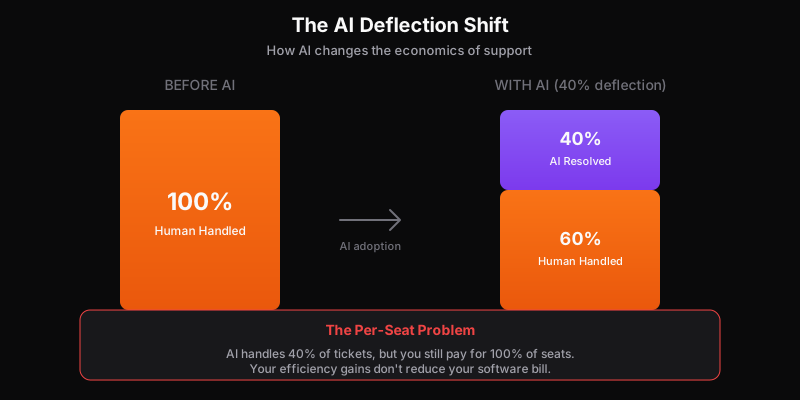
The Mismatch
Consider what happens when you deploy AI on a per-seat support platform:
Before AI:
- 5,000 tickets/month
- 8 support agents handle everything
- Software cost: 8 seats × $99 = $792/month
- All tickets require human time
After AI (40% deflection):
- 5,000 tickets/month (same volume)
- AI handles 2,000 automatically
- 8 agents handle remaining 3,000
- Software cost: Still 8 seats × $99 = $792/month
Your cost per ticket dropped dramatically. Your efficiency improved by 40%. Your software bill? Unchanged.
The agents who were handling 625 tickets each are now handling 375. You could theoretically reduce headcount—but most companies don’t want to fire people for being more efficient. Instead, they’d rather have agents focus on complex issues, improve quality, or handle growth without adding staff.
Either way, the software vendor captures none of the value they helped create, and you pay the same for less.
Why Per-Ticket Pricing Aligns with AI
Per-ticket pricing works differently:
Before AI:
- 5,000 tickets/month
- Software cost: $99/month (10,000 ticket tier)
- Cost per ticket: $0.02
After AI (40% deflection):
- 5,000 inquiries, but AI resolves 2,000 before they become tickets
- 3,000 tickets actually created
- Software cost: Still $99/month (well under tier limit)
- Or: Your volume was higher, AI brought it down, and you stay in a lower tier
With per-ticket pricing, AI efficiency either keeps you in a lower tier or gives you headroom for growth. The economics reward automation instead of ignoring it.
The Deeper Problem with Per-Seat
Per-seat pricing doesn’t just fail to capture AI efficiency—it actively discourages the organizational changes that make AI work well.
AI works best with broad context. The more your AI knows about your product, customers, and common issues, the better it performs. That knowledge often sits with engineers, product managers, and executives—people who don’t have support seats.
AI needs human oversight. Someone needs to review AI responses, catch errors, and improve the model. Under per-seat pricing, every person in that feedback loop costs money—so you minimize the loop.
AI changes who handles support. When AI handles the routine, humans handle the complex. Those complex issues often need expertise from outside the support team. But bringing in specialists means buying more seats.
Per-seat pricing creates friction at exactly the moments where AI needs human collaboration to work well.
The Economics in Detail
Let’s model a realistic AI deployment:
Starting point:
- 10,000 tickets/month
- 12 support agents
- Per-seat cost: $1,188/month ($99/seat)
- Average handle time: 10 minutes
- Fully-loaded agent cost: $30/hour
- Human cost per ticket: $5.00
With AI handling 40% of tickets:
- AI resolves 4,000 tickets instantly
- Humans handle 6,000 tickets
- AI cost: $0.50/ticket × 4,000 = $2,000/month
- Human cost: $5.00/ticket × 6,000 = $30,000/month
- Total handling cost: $32,000/month
Per-seat software cost: Still $1,188/month
- No reduction despite 40% efficiency gain
- Effectively paying for unused capacity
Per-ticket software cost: $99/month
- Same tier, massive headroom
- Or volume dropped enough to use lower tier
The per-ticket model saves $1,089/month in software alone. But more importantly, it doesn’t punish you for adding the people who make AI better—product managers reviewing AI responses, engineers improving integrations, executives checking on key accounts.
What Changes with Agentic AI
The current generation of AI handles straightforward tickets: order status, password resets, FAQ answers. The next generation—agentic AI—will handle multi-step workflows:
- Investigating a billing discrepancy across multiple systems
- Processing a return that requires checking inventory, issuing a refund, and generating a shipping label
- Troubleshooting a technical issue by querying logs and documentation
When AI can do this, the human role shifts even further. Agents become supervisors, trainers, and escalation handlers. The ratio of tickets to humans changes dramatically.
Per-seat pricing assumes that ratio stays constant. Per-ticket pricing adapts automatically.
The Vendor Incentive Problem
Here’s an uncomfortable truth: per-seat vendors aren’t incentivized to make AI work well for you.
Think about it from their perspective. If they sell you AI that deflects 50% of tickets, you might decide you need fewer seats. Their revenue drops. They’re actively working against their own business model.
Per-ticket vendors have the opposite incentive. If AI reduces your tickets, you’re happy and you stay. If AI helps you handle more volume without hiring, you grow. Either way, the relationship stays healthy.
This isn’t about vendor ethics—it’s about structural alignment. When pricing aligns with outcomes, everyone pulls in the same direction.
Making the Transition
If you’re currently on per-seat pricing and deploying AI, consider:
Calculate the true gap: What are you paying per seat? How many seats would you need if everyone who touches support (including AI oversight) had access? How does that compare to per-ticket options?
For help with this calculation, see our guide on support pricing models compared.
Model the AI future: If AI deflection reaches 50% in two years, what happens to your costs under each model? Per-seat stays flat. Per-ticket drops or absorbs growth.
Consider the access question: AI works better with more context. Per-ticket pricing with unlimited users means anyone can contribute to AI training, oversight, and improvement—without incremental cost.
The Inevitable Shift
Per-seat pricing made sense when:
- Humans handled every ticket
- Support was a specialized department
- The number of agents directly correlated with capacity
None of those assumptions hold anymore. Support is distributed. AI handles the routine. The limiting factor isn’t seats—it’s tickets.
The vendors who recognize this are moving to usage-based models. The ones who don’t are selling into an increasingly outdated reality. For a comprehensive analysis of when each model makes sense, see our complete guide to per-ticket vs per-seat pricing.
AI is making support more efficient. Your pricing model should let you capture that efficiency, not ignore it.
Ready to see what AI-friendly pricing looks like? Get early access to experience the difference.
For the complete guide to building modern support operations, see the SaaS Customer Support Playbook.
Ready to get started?
Join the waitlist and start building better customer support into your product.
Get Early AccessFrequently Asked Questions
AI can deflect 30-50% of support tickets automatically. With per-ticket pricing, your costs drop proportionally as AI handles more. With per-seat pricing, you pay the same regardless of AI deflection—you still need human seats for oversight and escalations.
AI won't replace agents but will change their role. AI handles repetitive, straightforward tickets while humans focus on complex issues requiring empathy and judgment. The result is fewer tickets per human, but each human handles more valuable interactions.
Per-ticket or usage-based pricing aligns with AI automation. As AI resolves more tickets, your costs decrease. Per-seat pricing doesn't capture efficiency gains—you need the same number of seats for human oversight regardless of AI deflection rates.