Support Software ROI Guide
How to calculate the real return on investment for support software, including the metrics that actually matter to CFOs and finance teams.
Getting budget approval for support software isn’t about features—it’s about numbers. Finance teams don’t care that your new platform has “AI-powered ticket routing.” They care whether it will save money, generate revenue, or both.
Here’s how to build a business case that speaks their language.
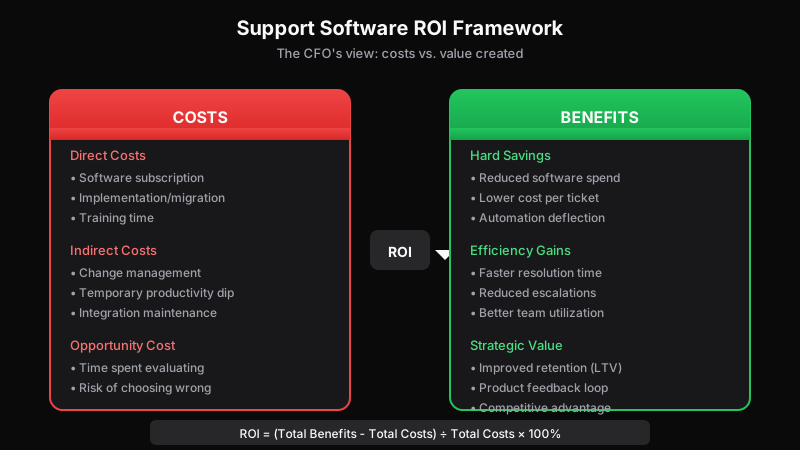
The ROI Formula
At its core, ROI is simple:
ROI = (Benefits - Costs) ÷ Costs × 100%A 200% ROI means you get $3 back for every $1 invested. But the tricky part is accurately quantifying both sides of the equation.
Calculating Total Costs
Start with the easy numbers, then dig into the hidden ones.
Direct Costs
Software subscription: The sticker price. For per-seat models, multiply by everyone who needs access—not just who currently has it. For per-ticket models, estimate based on your volume.
Implementation: Migration, setup, integrations. Ask vendors for typical implementation timelines and multiply by your team’s hourly cost. Don’t forget:
- Data migration (exporting and importing ticket history)
- Integration setup (CRM, communication tools, etc.)
- Custom configuration (workflows, automations, templates)
Training: Hours to get proficient × Number of users × Hourly cost. A 4-hour training for 10 people at $30/hour = $1,200. Simple systems need less; complex ones need more.
Indirect Costs
Change management: New tools create friction. Productivity typically dips 10-20% during the transition period. If your support team handles $50,000/month in labor and you expect a 2-month adjustment period with 15% productivity loss, that’s $15,000 in indirect cost.
Integration maintenance: APIs break. Vendors change things. Budget 2-5 hours/month for ongoing integration maintenance at engineering rates.
Opportunity cost: The time spent evaluating, implementing, and adjusting could be spent elsewhere. It’s real, even if hard to quantify.
Example Cost Calculation
| Cost Type | Year 1 | Ongoing (Annual) |
|---|---|---|
| Software | $6,000 | $6,000 |
| Implementation | $3,000 | $0 |
| Training | $1,500 | $500 |
| Productivity dip | $5,000 | $0 |
| Integration maintenance | $2,000 | $2,000 |
| Total | $17,500 | $8,500 |
Calculating Total Benefits
This is where most business cases fall short. They stop at “we’ll save $X on software.” That’s often the smallest benefit.
Hard Savings (Quantifiable)
Software cost reduction: If switching from per-seat to per-ticket pricing, this can be dramatic. Use the cost per ticket formula to calculate accurately.
Example:
- Current: 15 seats × $79 = $1,185/month = $14,220/year
- New: Per-ticket at $99/month = $1,188/year
- Annual savings: $13,032
Labor efficiency: Faster resolution times translate directly to labor savings. If you reduce average handle time by 20%:
- Current: 5,000 tickets × 10 min × $0.50/min = $25,000/month
- New: 5,000 tickets × 8 min × $0.50/min = $20,000/month
- Annual savings: $60,000
Automation deflection: Tickets that AI handles instead of humans:
- Tickets deflected: 1,500/month
- Human cost per ticket: $5
- AI cost per ticket: $0.50
- Annual savings: $81,000
Efficiency Gains (Partially Quantifiable)
Reduced escalations: When the right people have access, fewer tickets bounce between teams. If escalations drop from 15% to 10%, and each escalation adds 20 minutes of time:
- 5,000 tickets × 5% reduction × 20 min × $0.75/min = $3,750/month
- Annual savings: $45,000
Faster first response: Customers who wait less are less likely to send follow-ups. If faster responses reduce “checking in” tickets by 10%:
- 500 fewer tickets/month × $5/ticket = $2,500/month
- Annual savings: $30,000
Strategic Value (Estimate Carefully)
Customer retention: Better support increases customer lifetime value. This is the hardest to quantify but often the largest benefit.
Conservative approach: If your annual churn rate is 10% and better support could reduce it to 9%, and average customer value is $1,000/year:
- 1,000 customers × 1% improvement × $1,000 = $10,000/year
- But retained customers compound, so the real value is higher
Product improvement velocity: When product teams see customer feedback directly, they build better features faster. This is real but nearly impossible to quantify. Include it qualitatively.
Competitive differentiation: Support quality increasingly drives purchasing decisions. Again, hard to quantify but worth mentioning.
Example Benefits Calculation
| Benefit Type | Annual Value |
|---|---|
| Software savings | $13,032 |
| Labor efficiency | $60,000 |
| Automation deflection | $81,000 |
| Reduced escalations | $45,000 |
| Faster response savings | $30,000 |
| Retention improvement | $10,000 |
| Total | $239,032 |
Calculating ROI
Using our examples:
Year 1:
- Benefits: $239,032
- Costs: $17,500
- ROI: ($239,032 - $17,500) ÷ $17,500 = 1,266%
Ongoing years:
- Benefits: $239,032
- Costs: $8,500
- ROI: ($239,032 - $8,500) ÷ $8,500 = 2,712%
These numbers might seem high, but they’re realistic for companies switching from restrictive per-seat pricing to efficient per-ticket models with modern automation.
Presenting to Finance
Finance teams are skeptical of optimistic projections. Here’s how to build credibility:
Be Conservative
Use the low end of ranges. If you estimate 20-30% efficiency gain, use 15% in your model. Under-promise, over-deliver.
Show Your Math
Include all assumptions. “We assume 5,000 tickets/month based on current volume, growing at 10% annually” is more credible than a magic number.
Address Risks
What could go wrong? Implementation delays, adoption resistance, lower-than-expected automation rates. Acknowledge them and explain mitigation strategies.
Compare Scenarios
Show three cases: conservative, expected, and optimistic. This demonstrates thoughtfulness and lets finance pick their comfort level.
Use Their Metrics
If your company uses specific financial frameworks (payback period, NPV, IRR), translate your analysis into those terms. Ask finance what they need to see.
The Hidden Benefit: Access
One benefit that’s hard to quantify but crucial to mention: removing access restrictions.
Per-seat pricing creates artificial barriers. Engineers can’t see bug reports. Product can’t access feature requests. Executives are locked out of customer conversations.
These restrictions don’t just cost money—they degrade decision-making across the organization. When you switch to unlimited-user pricing, the entire company gets smarter about customers.
For more on how access affects costs, see our analysis of why startups shouldn’t pay per-seat.
The Payback Question
Finance often asks: “How long until we break even?”
Using our example:
- Year 1 costs: $17,500
- Year 1 benefits: $239,032
- Payback period: ~1 month
Even with conservative estimates (cut benefits in half), you’re looking at a 2-3 month payback. That’s a compelling investment.
Making the Ask
When you present the business case:
-
Lead with the ROI. “This investment returns 1,200% in year one.”
-
Show the cost of inaction. “Continuing with our current tool costs us $X in inefficiency annually.”
-
Quantify the risk of delay. Every month you wait, you’re paying the delta between current and potential costs.
-
Propose a pilot. If full commitment feels risky, suggest a limited pilot with clear success metrics.
Support software isn’t an expense—it’s infrastructure that drives retention, efficiency, and product quality. Frame it that way, back it with numbers, and the business case makes itself.
Ready to model your own ROI? See our pricing or get early access to run the numbers for your team.
Ready to get started?
Join the waitlist and start building better customer support into your product.
Get Early Access