Should Founders Do Support?
Why the most successful founders never fully step away from customer support, and how to balance founder time with scalable support operations.
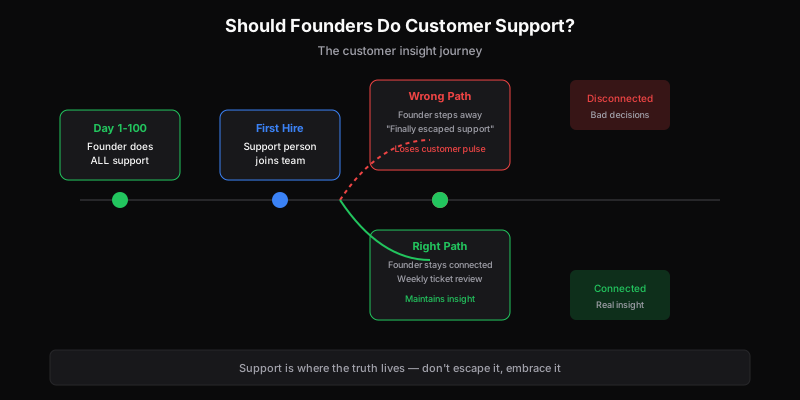
There’s a milestone most founders look forward to: the day they can finally stop answering support tickets and focus on “real” work—product strategy, fundraising, hiring. But some of the most successful companies were built by founders who never fully stepped away from support. And the data suggests they might be onto something.
The Conventional Wisdom Is Wrong
The standard startup playbook goes something like this: founders do everything in the early days, including support. Then you hire your first support person around 10-20 employees. You scale the support team. Eventually, support becomes a department you review in quarterly business reviews but rarely think about day-to-day.
This playbook optimizes for one thing: founder time. And it makes sense on the surface. Founder time is expensive. Every hour spent on support is an hour not spent on fundraising, strategy, or product vision.
But here’s what this calculus misses: support is where the truth lives.
Product managers interpret customer needs. Sales reps filter feedback through their incentives. Analytics dashboards show you what happened, not why. But support tickets? They’re unfiltered reality. They’re customers telling you exactly what’s broken, confusing, or missing—in their own words, at their moment of maximum frustration or delight.
What Founders Learn From Support That They Can’t Learn Anywhere Else
1. The Gap Between What You Built and What Customers Expected
Every product has assumptions baked in. The founder thought the workflow was obvious. The onboarding seemed clear. The feature seemed useful.
Support tickets reveal the gap between intention and reality. They show you where customers get stuck, where they expected something different, where your mental model diverges from theirs.
This isn’t the kind of insight that survives translation. When a support agent writes a summary for a product review, they’ve already interpreted the issue. They’ve categorized it. They’ve stripped out the emotional context, the exact wording, the pattern of confusion.
Founders who read raw tickets develop an intuition for their product that can’t be acquired through reports and summaries.
2. The Language Your Customers Actually Use
Marketing teams spend thousands on customer research to figure out how customers describe their problems. Founders doing support get this for free.
You learn that customers don’t say “I need multi-tenant workspace isolation.” They say “I have three brands and I don’t want tickets mixing together.” You learn that “API-first” doesn’t resonate, but “I can build my own portal” does.
This language becomes the foundation for positioning, messaging, and product naming. It’s the difference between marketing that sounds like your customers and marketing that sounds like you.
3. Which Problems Are Actually Urgent
Product roadmaps are usually built from a combination of customer requests, competitive analysis, and internal vision. But not all problems are created equal.
Support gives you urgency signals you can’t get anywhere else. When a customer writes in at 2 AM because something is blocking their launch, that’s a different signal than a feature request submitted through a feedback form. When three customers mention the same issue in a week, that’s different from a support agent mentioning it in a monthly report.
Founders in support learn to distinguish between “nice to have” and “this is actively costing us customers.”
4. Who Your Real Power Users Are
Every product has a segment of customers who push it harder than anyone else. They find edge cases. They request advanced features. They use the product in ways you never anticipated.
These customers often surface through support before they show up in any analytics. They’re the ones asking “can I do X?” when X is something you never considered. They’re the ones working around limitations in creative ways.
Founders who recognize these customers early can build relationships that inform product direction for years. They’re often the same customers who become your best case studies, your most vocal advocates, and your beta testers for new features.
The Brian Chesky Model
Airbnb’s Brian Chesky famously spent significant time doing customer support, even as the company scaled. He didn’t do it because he had to—he had plenty of people who could handle tickets. He did it because it kept him connected to reality.
The practice gave him unfiltered access to the customer experience. When Chesky talked about product decisions, he spoke with the authority of someone who had just been in the trenches, not someone interpreting reports.
This isn’t unique to Airbnb. Many successful founders maintain some connection to support:
- Basecamp’s Jason Fried has written extensively about the value of everyone doing support
- Stripe’s Patrick Collison was known for personally responding to developer support issues
- Zapier’s Wade Foster kept doing support long after the company could have insulated him from it
The pattern isn’t accidental. These founders recognized that support isn’t a burden to escape—it’s an asset to preserve.
When Founders Should Do Support (And When They Shouldn’t)
Do Support When:
You’re pre-product-market fit. In the early days, every customer interaction is gold. You’re not just solving problems—you’re learning what problems matter, what solutions resonate, and what your product actually is.
You’re launching something new. Every new feature, new market, or major change creates a mini pre-PMF moment. Founder involvement during these periods catches issues faster and builds conviction about what’s working.
You’re losing customers you shouldn’t be losing. When churn spikes or retention drops, founders should get back into support. The data will tell you what’s happening; support will tell you why.
Your support quality is slipping. If CSAT drops or response times balloon, founder attention often diagnoses problems faster than any audit.
Delegate Support When:
Volume exceeds capacity. If you’re choosing between doing support and doing something only you can do (key sales call, board meeting, critical hire), delegate support.
You’ve established patterns. Once you’ve done enough support to document the common issues, train others on your standards, and build systems for escalation, you can step back without losing the connection.
You have people who are better at it. Some people are naturally gifted at support—more patient, more empathetic, better at explaining. Let them own it while you maintain a lighter touch.
The “Office Hours” Model
Many founders find a middle ground: they don’t do support full-time, but they maintain regular, scheduled exposure.
Weekly ticket review: Spend 30-60 minutes each week reading a random sample of recent tickets. Not summaries—actual tickets. You’ll spot patterns and problems that filtered reports miss.
Escalation channel: Be the final escalation for certain types of issues. Not every issue, but the ones that matter most: enterprise customers, technical edge cases, situations where customers are considering leaving.
Monthly support shifts: Some founders do a half-day of frontline support each month. It’s enough to stay calibrated without becoming a bottleneck.
New feature support: Personally handle support for the first week after any major launch. You’ll learn faster than any retrospective could teach you.
The Tools Question
Here’s where tooling matters: founders staying close to support need systems that make it easy to dip in without disrupting the team.
Traditional helpdesks often have per-seat pricing, which creates a perverse incentive: adding the founder as a user means paying another $50-150/month. So founders stay out. Engineers who should see support stay out. Product managers who should see support stay out.
This is backwards. You want more eyes on support, not fewer. The marginal cost of adding a reader should be zero.
Per-ticket pricing models solve this. Pay for your actual support volume, not the number of people who can view tickets. Founders can dip in, engineers can access bug reports, PMs can see feature requests—all without incrementing your bill.
It seems like a small detail, but pricing models shape behavior. When adding viewers costs money, companies add fewer viewers. When it’s free, everyone who should be looking at support can look at support.
What Changes When the Founder Steps Back
At some point, every successful company reaches a scale where the founder can’t (and shouldn’t) be in every ticket. That’s healthy. But the transition matters. (For more on this transition, see our startup help desk guide.)
What You Lose
- Unfiltered signal: Everything now passes through interpretation. Summaries replace raw data. Reports replace conversations.
- Speed of learning: Support agents see patterns over days. Founders doing support see them instantly.
- Credibility with the team: Support teams work harder when they know leadership is paying attention. Not in a surveillance way—in a “this work matters” way.
What You Preserve
Good founders don’t fully disconnect. They maintain:
- Regular ticket review: Even if they’re not responding, they’re reading.
- Escalation path: For issues that truly matter, there’s a path to founder attention.
- Cultural emphasis: Support isn’t a cost center—it’s an intelligence operation. The founder’s attitude toward support shapes the whole company’s attitude.
The ROI of Founder Time in Support
Let’s do the math on a specific scenario.
A founder spends 5 hours per week in support. Over a quarter, that’s 65 hours—roughly 1.6 weeks of full-time work.
What could that time produce?
- Pattern recognition: Catching a retention problem 2 weeks earlier might save 10-20 customers. At $500 ARR each, that’s $5,000-$10,000 preserved.
- Product insight: Identifying a feature gap that’s causing 30% of churned customers to leave. Fixing it changes the trajectory of the business.
- Positioning refinement: Learning how customers describe their problems, leading to messaging that converts 5% better.
- Team alignment: Support team that knows the founder cares, leading to higher retention and better performance.
The ROI is hard to quantify precisely, but it’s almost certainly positive. The opportunity cost of founder time elsewhere would need to be extraordinarily high to overcome the value of staying connected to customers.
Practical Implementation
If you’re a founder who’s stepped away from support and wants to reconnect:
Start Small
Don’t announce a big initiative. Just start reading tickets. 30 minutes a day for a week will teach you more than any report.
Focus on New Customers
New customer tickets reveal onboarding gaps and first impressions. They’re high signal for understanding where your product confuses people.
Read the Angry Ones
Angry customers are often your best teachers. They’re not angry because they don’t care—they’re angry because they do. What they’re angry about is usually something that matters.
Don’t Undermine Your Team
If you’re going to respond to tickets, coordinate with your support team. Nothing demoralizes a support agent faster than the founder swooping in to “fix” things without context.
Build Escalation Paths
Make it easy for your support team to flag issues for your attention. “This customer mentioned leaving” or “This is the third time we’ve seen this bug” should trigger founder visibility.
The Bottom Line
The question isn’t really “should founders do support?” It’s “how do founders stay connected to customer reality?”
Support is one of the best mechanisms for that connection. It’s unfiltered, immediate, and constant. Founders who maintain it—even in small doses—make better decisions about product, positioning, and priorities.
The companies that treat support as a tax to be minimized are optimizing for the wrong thing. The best companies treat it as an intelligence operation, with the founder as the most important analyst.
Don’t be in a hurry to escape support. The insights you gain there might be the most valuable work you do.
Dispatch Tickets makes it easy for founders to stay connected to support without breaking the budget. With per-ticket pricing and unlimited users, everyone who should see customer conversations can see them—including founders who want to stay close to the customer voice.
Ready to get started?
Join the waitlist and start building better customer support into your product.
Get Early AccessFrequently Asked Questions
Founders should never fully stop—they should transition from doing all support to maintaining regular exposure. Consider stepping back when support takes more than 10 hours/week, response times slip, most tickets are repetitive, or you've documented your standards. Even then, maintain weekly ticket reviews and an escalation path for important issues.
In early days (pre-product-market fit), as much as needed. As you scale, aim for 2-5 hours per week: a 30-minute daily ticket review, handling key escalations, and owning support for new feature launches. The goal is staying calibrated, not being in the queue full-time.
Four things: (1) The gap between what you built and what customers expected, (2) The exact language customers use to describe their problems, (3) Which problems are genuinely urgent vs. nice-to-have, and (4) Who your power users are before they show up in analytics. This signal doesn't survive translation through reports and summaries.
Common approaches include weekly ticket reviews (30-60 minutes reading random samples), being the final escalation for important issues, monthly support shifts, and personally handling support for new feature launches. The key is maintaining direct exposure without becoming a bottleneck.