Should Engineers See Support Tickets?
Why giving engineers direct access to customer support conversations improves product quality, accelerates bug fixes, and builds better engineering culture.
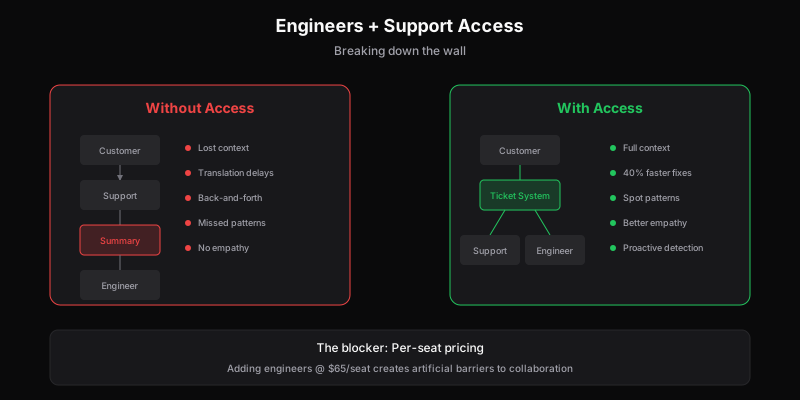
In most companies, there’s an invisible wall between engineering and support. Support agents handle customer issues. When something needs engineering attention, they write up a summary, file a ticket in Jira, and wait. Engineers see the interpreted version—stripped of context, customer emotion, and often the details that would make diagnosis faster.
This wall exists for good reasons: engineers need focus time, support volumes can be overwhelming, and there’s a genuine skill difference between handling customers and fixing code.
But the wall has costs. And increasingly, the best engineering teams are finding ways to tear it down.
The Hidden Costs of Keeping Engineers Away From Support
1. Lost Context in Translation
When a support agent translates a customer issue into an engineering ticket, information is inevitably lost. The customer said “the thing broke when I clicked the button.” The support agent interprets this as “crash on button click.” The engineer sees the ticket and has to guess: which button? What were they doing before? What browser? What did “broke” actually mean?
The back-and-forth that follows—engineer asks support, support asks customer, customer has moved on—adds days to resolution time. If the engineer had seen the original conversation, they might have diagnosed the issue in minutes.
2. Lack of Urgency Signal
Support tickets carry emotional weight. A customer’s frustration, their business impact, their deadline—these things come through in their words. When that gets translated into a priority label (P2) and a one-line description, the urgency disappears.
Engineers who see raw support conversations develop better intuition for what actually matters. “This is blocking our launch next week” hits differently than “Priority: High.”
3. Missed Patterns
Support agents see patterns within support. Engineers see patterns within code. But the patterns that matter most are often invisible to both—the connection between a code change last week and the support spike this week.
Engineers with access to support can spot correlations that support agents can’t: “Wait, all these users are on iOS 17.2” or “These all happened after we deployed the new caching layer.”
4. Empathy Deficit
It’s easy to dismiss bug reports when you’ve never talked to the humans affected. “Edge case.” “User error.” “Working as intended.”
Engineers who see the real impact—the frustrated customer, the business on the line, the workaround that’s costing them hours—make different prioritization decisions. Not because they’re told to, but because they genuinely understand what’s at stake.
The Case for Direct Access
Faster Bug Resolution
The single biggest benefit of engineer access to support is speed. When an engineer can see the original report, the customer’s environment, and the full conversation history, they can often diagnose issues without a single question.
A study at one enterprise software company found that bug resolution time dropped 40% after giving engineers read access to support conversations. The difference wasn’t magic—it was context.
Better Bug Reports
Engineers who regularly see how their code fails in the wild write better code and better documentation. They learn what information customers provide (and don’t provide), what error messages are actually useful, and what edge cases they hadn’t considered.
This feedback loop makes the whole product more robust over time.
Proactive Problem Detection
Engineers browsing support can spot issues before they become crises. They see the early complaints that support agents might not recognize as connected. They notice when something that worked fine is suddenly generating confusion.
This early warning system catches problems when they’re small and fixable, not when they’ve escalated to a VP asking “why are we getting so many complaints about X?”
Technical Escalation Without Telephone
When a customer reports something genuinely complex, engineers with support access can dive in directly. They can ask technical follow-up questions. They can request specific debugging information. They don’t have to play telephone through a support agent who’s trying to translate technical concepts they don’t fully understand.
Objections and How to Address Them
”Engineers Need Focus Time”
This is legitimate. Engineers can’t be effective if they’re constantly interrupted by support. But “access” doesn’t mean “obligation.”
The solution is to make support tickets readable, not interruptible. Engineers can browse support when they have time—during builds, after finishing a task, when they want a break from coding. They can search for issues related to code they’re working on. They can subscribe to specific topics or error types.
The goal isn’t to put engineers on the support queue. It’s to give them a window into what’s happening.
”Support Volume Is Overwhelming”
If you have thousands of tickets a day, raw access would indeed be overwhelming. But engineers don’t need to see everything.
Smart filtering helps: bugs only, technical issues only, issues mentioning specific features. Tagging and categorization let engineers see the slice that’s relevant to their work without wading through password resets and billing questions.
”Engineers Aren’t Trained for Customer Interaction”
True—and they don’t need to be. Read access is different from response access. Most engineers shouldn’t be replying to customer tickets. They should be reading them for context and insight.
When engineers do need to engage customers (for technical debugging, for example), they can do it with support team oversight or through internal collaboration, not by taking over the customer conversation.
”It’ll Create Conflict With the Support Team”
This is the real concern, and it requires cultural work. Support teams can feel undermined if engineers swoop in to “fix” things or second-guess their categorization.
The key is framing access as collaboration, not oversight. Engineers are there to learn and help, not to audit or criticize. Support teams should see engineer access as a resource—“I can flag this for an engineer who’s already watching these issues”—not as surveillance.
Models That Work
The “All Engineers Do Support” Rotation
Some companies put every engineer on support for a few hours per week or a few days per month. Basecamp pioneered this approach, and many companies have adopted it.
Pros:
- Maximum empathy and exposure
- Everyone understands customer pain
- No permanent barrier between engineering and support
Cons:
- Context switching costs
- Not all engineers are good at it
- Can feel like punishment if not culturally embedded
The Read-Only Window
More common: engineers get read access to support but don’t respond to customers. They can browse, search, and observe. When they spot something actionable, they work through the support team or fix it directly in code.
Pros:
- Low overhead
- No training required
- Engineers self-select into relevant issues
Cons:
- Passive—engineers have to choose to look
- Easy to ignore if not part of workflow
The “Bug Channel” Integration
Support tags potential bugs. Those tags trigger notifications to relevant engineering channels (Slack, email, etc.). Engineers see bug reports as they happen, with full context, without having to browse support proactively.
Pros:
- Low noise—engineers only see what’s relevant
- Fast escalation for real issues
- Support team stays in control of categorization
Cons:
- Depends on support tagging accuracy
- Misses patterns that span multiple tickets
The On-Call Overlap
Engineering on-call includes a support component. The on-call engineer monitors support for technical issues, not to respond to customers, but to catch emerging problems before they escalate.
Pros:
- Clear responsibility
- Built into existing on-call rotation
- Fast escalation path
Cons:
- Only works for teams with on-call
- Can be narrow (infrastructure vs. product bugs)
What Changes When You Open Access
Product Quality Improves
Engineers who see their bugs through customer eyes fix them faster and more completely. They stop saying “works on my machine” when they’ve seen it not work for ten different customers. This is especially critical for technical SaaS support where engineers and support need to work closely together.
Documentation Gets Better
When engineers see what confuses customers, they write better docs, better error messages, and better onboarding flows. The feedback loop that used to be invisible becomes obvious.
Prioritization Gets Smarter
Product and engineering decisions start to incorporate real customer pain. Not the interpreted, summarized, categorized version—the raw signal.
Support Team Feels Valued
Counter-intuitively, opening access to engineering often makes support teams feel more valued, not less. Their work is visible. Their insights reach the people who can act on them. They’re no longer shouting into a void.
Engineers Stay Longer
Engineers who feel connected to customers—who see the impact of their work—report higher job satisfaction. They’re not just shipping code; they’re solving real problems for real people.
The Tooling Problem
Here’s where most companies get stuck: their helpdesk makes it expensive to add engineers.
Per-seat pricing means every engineer who gets access is another $50-150/month. Add 20 engineers, and you’re looking at $1,000-$3,000/month just for read access. (See our breakdown of the hidden costs of per-agent pricing.)
So companies ration access. “Only the senior engineers.” “Only the ones working on this feature.” “Only for this sprint while we debug.” The cost structure pushes toward less access, not more.
This is backwards. The incremental cost of adding a reader should be zero. You’re not using more support resources when an engineer reads a ticket—you’re actually using fewer, because you’re reducing the translation overhead.
Per-ticket pricing models solve this by making the cost about support volume, not headcount. Add as many engineers as you want. Add PMs. Add designers. Add founders. Everyone who should see customer conversations can see them.
Implementation Playbook
If you want to give engineers better access to support, here’s how to start:
Step 1: Start With Read Access
Don’t ask engineers to respond to tickets. Just let them see them. This is low risk, low training, and immediately valuable.
Step 2: Create Relevant Filters
Set up views or tags for “potential bugs,” “technical issues,” “API problems,” or whatever categories map to engineering work. Make it easy for engineers to see signal without noise.
Step 3: Build Integration Hooks
Connect support to engineering tools. When a ticket is tagged as a bug, it should appear in Jira or Linear or wherever engineers track work. Include a link back to the full support conversation. API-first helpdesks make this straightforward with webhooks and complete API access.
Step 4: Establish Norms
Be clear about expectations. Engineers should read, not respond. They should collaborate with support, not bypass them. They should flag issues, not criticize categorization.
Step 5: Measure Impact
Track bug resolution time, time-to-acknowledgment, and customer satisfaction for technical issues. The numbers should improve. If they don’t, adjust the model.
Common Mistakes
Mistake: Full Queue Access Without Filtering
Engineers see everything, get overwhelmed, and stop looking. Access should be curated—bugs and technical issues, not password resets.
Mistake: Expecting Engineers to Respond to Customers
Most engineers aren’t trained for customer communication. Read access is the goal; response access creates risk.
Mistake: Bypassing Support
Engineers shouldn’t reach out to customers directly without coordination. This confuses customers and undermines the support team.
Mistake: Treating It as Punishment
If support rotation feels like a chore, it will be resented. Frame it as learning, context-building, and customer connection—not as “paying dues.”
The Bottom Line
The wall between engineering and support exists for good reasons, but it’s often too high. Engineers with access to customer conversations make better decisions, fix bugs faster, and build more empathy for the people who use their code.
You don’t need to put every engineer on the support queue. You need to give them a window into what’s happening—a way to see the raw signal, not just the interpreted version.
The tooling should support this, not obstruct it. When adding a reader costs as much as adding a full-time support agent, companies build walls instead of windows. When adding a reader is free, everyone who should have context can have it.
Open the window. The view is worth it.
Dispatch Tickets includes unlimited users at no extra cost. Engineers, PMs, founders—everyone can have visibility into customer conversations without incrementing your bill. See how per-ticket pricing changes who can see support.
Ready to get started?
Join the waitlist and start building better customer support into your product.
Get Early AccessFrequently Asked Questions
Four reasons: (1) Faster bug resolution—engineers with full context diagnose issues faster than those reading summaries, (2) Better pattern recognition—engineers spot technical correlations support agents miss, (3) Improved product quality—seeing real failures leads to more robust code, and (4) Greater empathy—understanding customer impact changes prioritization decisions.
Access doesn't mean obligation. Engineers can browse support during natural breaks—during builds, after finishing tasks, or when they want context on code they're working on. The goal isn't putting engineers on the support queue; it's giving them a window into customer reality when they need it.
Frame access as collaboration, not oversight. Engineers should have read access for context, not response access that bypasses support. When engineers need to engage customers for debugging, they should coordinate with support rather than taking over conversations. Support teams often appreciate engineer access because their insights finally reach people who can act on them.
Options include: (1) Read-only window where engineers can browse and search but not respond, (2) Bug channel integration where support-tagged bugs notify relevant engineering channels, (3) On-call overlap where the on-call engineer monitors support for technical issues. Start with read-only access and evolve based on team needs.