E-commerce Support Cost Savings
E-commerce support has unique challenges: seasonality, high volume, and multiple channels. Here's how smart brands are dramatically reducing costs without sacrificing quality.
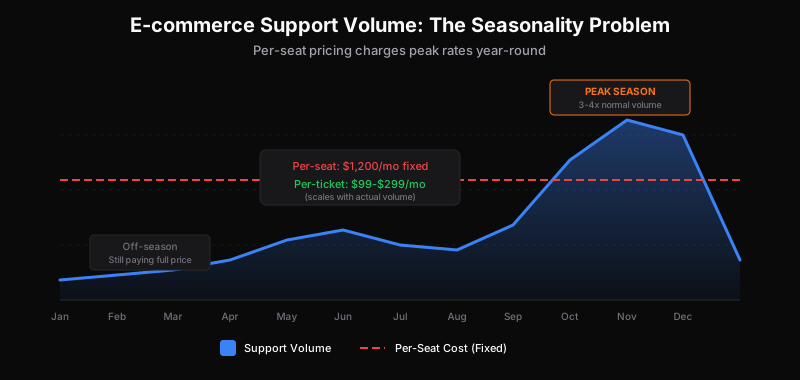
E-commerce support is a different beast. You’re not dealing with a steady trickle of technical issues—you’re managing waves of “where is my order?” inquiries that spike 3-4x during peak seasons, then drop back down while you’re still paying the same software bill.
The brands that figure this out don’t just save money. They turn support into a competitive advantage—fast responses, happy customers, repeat purchases.
Here’s how they’re doing it.
The E-commerce Support Problem
E-commerce support has characteristics that make traditional per-seat pricing especially painful:
Extreme seasonality. Black Friday through December can generate more tickets than the other 10 months combined. You either staff (and pay) for peak or scramble to catch up.
Predictable query types. 60-70% of e-commerce tickets are variations of five questions: order status, shipping time, returns process, sizing help, and payment issues.
Multiple touchpoints. Customers reach out via email, chat, social, SMS, and review platforms. Each channel needs attention.
Thin margins. Unlike SaaS, where support cost is a small percentage of customer value, e-commerce margins are tight. A $3 support interaction on a $30 order is a 10% hit.
These factors make cost efficiency critical—but per-seat pricing doesn’t flex with any of them.
Why Per-Seat Fails for E-commerce
Consider a mid-size DTC brand:
- 3,000 tickets/month average (8,000+ during peak)
- 4 support agents plus 8 other staff needing access
- Customer service, fulfillment, marketing, and executives all touch tickets
Per-seat pricing at $79/seat:
- 12 seats × $79 = $948/month
- During slow January: $948 (for handling 2,000 tickets)
- During peak November: $948 (for handling 8,000 tickets)
- Cost per ticket swings from $0.47 to $0.12 depending on season
You’re paying a premium during slow periods and getting a “deal” when you’re already stressed to capacity. The economics are backwards.
Per-ticket pricing at $99/month (10,000 tickets):
- $99/month regardless of team size
- Costs track actual volume
- All 12 team members included
The savings are significant, but the operational benefit matters more: everyone who needs visibility gets it.
The Four Levers for 80% Cost Reduction
Brands achieving dramatic cost reductions pull four levers simultaneously:
1. Switch to Usage-Based Pricing
The first lever is structural: stop paying for seats you don’t fully use.
For our example brand:
- Per-seat: $948/month
- Per-ticket: $99/month
- Immediate savings: $849/month (89%)
This alone is often enough to fund the other improvements.
2. Deflect with Self-Service
Most e-commerce tickets don’t need a human. Customers asking “where is my order?” want information, not interaction.
Effective deflection tools:
- Order tracking pages that work (and are easy to find)
- Sizing guides with actual measurements
- Return/exchange flows that don’t require emailing support
- FAQs that answer real questions (not marketing fluff)
Brands with good self-service deflect 30-50% of potential tickets. That’s 30-50% fewer tickets without any change to team size.
3. Automate the Repetitive
The tickets that do come in often follow patterns. “What’s the status of order #12345?” can be answered by looking up tracking info—something AI does instantly.
Modern automation handles:
- Order status lookups (instant response, no human)
- Return initiation (gather info, create label)
- Sizing recommendations (based on previous orders)
- Payment status (check processor, explain issue)
At $0.50-1.00 per automated resolution vs. $5-10 for human handling, automation pays for itself immediately.
4. Enable Your Whole Team
Here’s the lever most brands miss: when support software costs per-seat, you restrict who can access it. That restriction creates friction.
The fulfillment manager who could answer a shipping question directly has to relay it through support. The marketing person who spots a campaign-related issue can’t see the tickets. The founder who wants to stay close to customers is locked out.
When access is unlimited:
- Cross-functional issues resolve faster
- Context doesn’t get lost in handoffs
- Problems get spotted by the people who can fix them
For a framework on calculating these hidden costs, see how to calculate your true cost per ticket.
A Real Scenario
Before optimization:
- 4,000 tickets/month
- 5 support agents + 3 other staff = 8 seats
- Per-seat pricing: 8 × $99 = $792/month
- Average handle time: 10 minutes
- Cost per ticket: ~$4.50 (including labor)
After optimization:
- Self-service deflects 35% → 2,600 tickets reaching support
- AI handles 25% → 650 tickets automated
- Human team handles 1,950 tickets
- Per-ticket pricing: $99/month (all staff included)
- Average handle time: 8 minutes (simpler tickets reach humans)
- Cost per ticket: ~$2.20
Results:
- Software cost: -87%
- Labor cost: -40% (same team, fewer tickets, faster resolution)
- Response time: -60% (AI responds instantly to automated tickets)
- Customer satisfaction: +15% (faster responses, fewer handoffs)
This isn’t theoretical. Brands that take support seriously are achieving these numbers.
The Multi-Brand Multiplier
If you run multiple brands or storefronts, the savings multiply.
Per-seat pricing typically means separate instances or expensive “enterprise” tiers for multi-brand support. Each brand needs its own seats.
Per-ticket pricing with proper multi-brand support lets you:
- Manage all brands in one system
- Share staff across brands without seat duplication
- Maintain brand-specific customization (different reply addresses, templates)
An agency managing 5 client brands might pay $3,950/month in per-seat fees ($790 × 5). With per-ticket pricing, that’s potentially $99-$299/month total.
For more on this specific challenge, see the multi-brand support problem.
Getting Started
If you’re an e-commerce brand paying per-seat, start here:
-
Count your true users. Not just support agents—everyone who needs to see customer conversations. The number is probably higher than you’re paying for.
-
Map your ticket types. What percentage are order status? Returns? Shipping? These categories tell you your deflection potential.
-
Calculate your true cost. Use the cost per ticket formula to understand what you’re actually spending.
-
Model the alternative. What would per-ticket pricing cost at your volume? Include the value of unlimited access.
The math almost always favors switching—especially for brands with seasonal volume and cross-functional teams.
E-commerce margins don’t leave room for inefficient support operations. The brands that thrive are the ones that treat support as infrastructure, not overhead.
Ready to see the math for your brand? Explore our e-commerce solutions or get early access to model your savings.
Ready to get started?
Join the waitlist and start building better customer support into your product.
Get Early Access