Support vs Service: The Difference
The terms are often used interchangeably, but they mean different things. Here's the distinction that matters—and why modern SaaS companies are blurring the line.
People use “customer support” and “customer service” interchangeably. For everyday conversation, that’s fine. But if you’re building a team, choosing tools, or defining strategy, the distinction matters.
Here’s what each term actually means, when the difference matters, and how modern software companies are rethinking both.
The Traditional Distinction
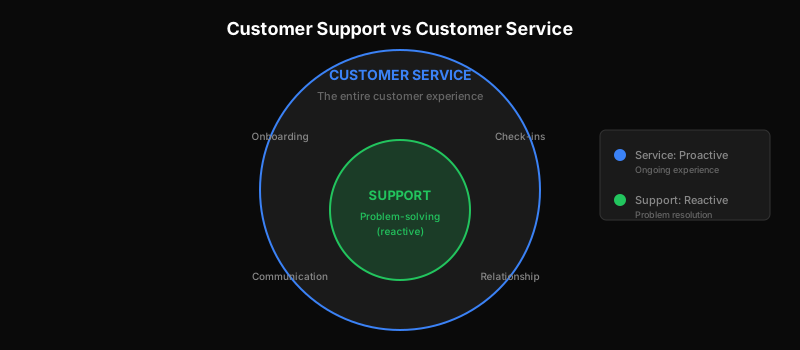
Customer service is the broader concept. It encompasses every interaction a customer has with your company that shapes their experience. This includes:
- How easy it is to buy
- How clear your communication is
- How pleasant your staff is to interact with
- How you handle complaints
- Everything that makes customers feel valued
Customer service is proactive and ongoing. It happens whether or not there’s a problem.
Customer support is a subset of customer service. It specifically refers to helping customers solve problems with your product or service:
- Troubleshooting technical issues
- Answering how-to questions
- Fixing bugs
- Processing returns or refunds
- Resolving account problems
Customer support is reactive. It happens when something goes wrong or when customers can’t figure something out on their own.
The Distinction in Practice
Here’s how the two play out differently:
| Aspect | Customer Service | Customer Support |
|---|---|---|
| Trigger | Any customer interaction | Problem or question |
| Timing | Continuous | Reactive |
| Metrics | NPS, satisfaction, loyalty | Resolution time, ticket volume |
| Scope | Entire customer experience | Product/service issues |
| Examples | Greeting, follow-ups, check-ins | Troubleshooting, bug fixes |
A Concrete Example
Imagine you run a SaaS company:
Customer service moments:
- Welcome email when they sign up
- Onboarding call to help them get started
- Check-in after their first month
- Birthday discount code
- Proactive notice about an upcoming feature they’ll like
Customer support moments:
- They can’t log in and need help
- They hit a bug and report it
- They don’t understand how a feature works
- They want a refund
- They need help with an integration
Both matter. But they require different skills, different tools, and often different people.
Does the Distinction Actually Matter?
For some businesses, not really. A small team might handle everything with the same people using the same tools. Whether you call it “support” or “service” doesn’t change what you do.
But the distinction matters when:
Building Teams
Customer service roles (like customer success managers) focus on relationship building, proactive outreach, and ensuring customers achieve their goals.
Customer support roles focus on resolving issues efficiently, technical troubleshooting, and handling ticket queues.
The skills overlap, but the emphasis is different. Great support agents are problem-solvers who think in terms of resolution. Great service people are relationship-builders who think in terms of outcomes.
Choosing Tools
Customer service needs tools for:
- Customer relationship management (CRM)
- Outreach and communication campaigns
- Customer health scoring
- Lifecycle automation
Customer support needs tools for:
- Ticket management
- Knowledge bases and self-service
- Bug tracking integration
- Response time tracking
Some platforms try to do both. They’re often mediocre at each. You might need separate tools for separate functions.
Measuring Success
Customer service metrics focus on the overall relationship:
- Net Promoter Score (NPS)
- Customer lifetime value
- Retention rate
- Expansion revenue
Customer support metrics focus on issue resolution:
- First response time
- Resolution time
- First contact resolution rate
- Ticket volume and trends
Conflating these leads to measuring the wrong things. A support team measured on NPS has different incentives than one measured on resolution time.
How SaaS Changes the Equation
In traditional businesses, customer service and customer support were clearly separate. You had retail staff (service) and a call center (support). Different people, different locations, different management.
SaaS has blurred this line in interesting ways.
Support Is Embedded in the Product
Modern SaaS treats support as a product feature, not a separate function. Help content appears contextually. Support widgets are embedded in the app. Errors include troubleshooting links.
This means “support” happens continuously—closer to the service model—rather than only when customers reach out.
Every Interaction Shapes Perception
With SaaS subscriptions, customers continuously decide whether to stay. A single support interaction can trigger churn or cement loyalty. Support quality is service quality.
This elevates support from “cost center that handles problems” to “strategic function that shapes retention.”
Self-Service Blurs the Line
When customers solve their own problems via documentation, is that support or service? Technically it’s both—they had a problem (support), but you proactively provided resources that helped (service).
The best SaaS companies optimize for self-service success, which sits squarely in the overlap between support and service.
The Whole Team Does Support
In traditional models, support was siloed. In modern SaaS, especially early-stage, everyone participates:
- Engineers answer technical questions
- Product managers handle feature requests
- Founders talk to customers directly
This distribution means “support” happens across the organization—again blurring the line with the broader “service” mindset.
The Modern Approach
Rather than debating terminology, successful SaaS companies focus on outcomes:
Reactive outcomes (traditional support):
- Problems get resolved quickly
- Customers aren’t blocked
- Issues inform product improvements
Proactive outcomes (traditional service):
- Customers achieve their goals
- Customers feel valued
- Relationships deepen over time
The organizational structure matters less than delivering both.
Building Blended Teams
Some companies build teams that explicitly blend both:
- Customer Success handles proactive relationship management AND reactive issue resolution for key accounts
- Technical Support handles complex technical issues AND builds self-service content
- Product Support sits between support and product, turning customer feedback into improvements
These hybrid roles recognize that the distinction between support and service is increasingly artificial.
Tool Consolidation
Modern tools often handle both functions:
- Ticketing for reactive support
- Customer data for proactive service
- Knowledge base for self-service
- Analytics across the full customer journey
Rather than separate tools for “support” and “service,” you might use one platform that treats customer interaction holistically.
What This Means for You
If you’re choosing what to call your team or function, consider your emphasis:
Call it “Customer Support” if:
- Primary focus is resolving problems and answering questions
- Success is measured by resolution metrics
- The role is primarily reactive
- Technical skills are important
Call it “Customer Service” if:
- Primary focus is overall customer experience
- Success is measured by relationship metrics
- The role includes proactive outreach
- Relationship skills are paramount
Call it “Customer Success” if:
- Focus is on ensuring customers achieve outcomes
- Success is measured by retention and expansion
- The role blends reactive and proactive
- You want to emphasize partnership over problem-solving
The name matters less than clarity about what the function does and how it’s measured.
The Bottom Line
Customer support and customer service have distinct definitions. Support is reactive problem-solving; service is the broader experience.
But modern SaaS increasingly blends the two. Products embed support. Self-service spans both categories. Every interaction shapes the relationship.
Rather than getting stuck on terminology, focus on what matters:
- Can customers solve problems easily?
- Do customers feel valued?
- Is feedback improving your product?
- Are customers achieving their goals?
Get those right, and it doesn’t matter what you call it.
Building a support function for your SaaS? See the complete SaaS Customer Support Playbook or get started with Dispatch Tickets.
Ready to get started?
Join the waitlist and start building better customer support into your product.
Get Early AccessFrequently Asked Questions
Customer service is the broader concept—every interaction shaping customer experience (buying process, communication, complaint handling). Customer support is a subset: specifically helping customers solve problems with your product (troubleshooting, how-to questions, bug fixes). Service is proactive and ongoing; support is reactive.
It matters for building teams (support = problem-solvers, service = relationship-builders), choosing tools (ticketing vs. CRM), and measuring success (resolution time vs. NPS). However, modern SaaS increasingly blurs the line—support is embedded in products, self-service spans both, and every interaction shapes the relationship.
Call it Support if the primary focus is resolving problems reactively with technical skills. Call it Service if the focus is overall experience with relationship skills. Call it Success if the focus is ensuring customers achieve outcomes, blending reactive and proactive work. The name matters less than clarity about what the function does.